
In shopping malls, inventory runs out when advertising starts delivering results, and ad budgets dry up when inventory is replenished. What Cafe24's marketing centre confirmed over 17 years of meeting clients was that marketing, inventory and cash were not separate problems but linked in a single chain. Cafe24 chose to break the bottleneck by using data to sort products to sell before advertising and by paying ad costs first and recovering them from sales.
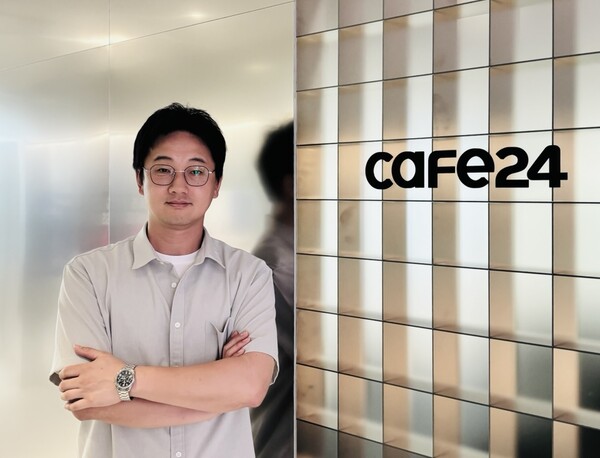
Ahn Eun-guk (안은국), a group team leader at Cafe24's marketing centre, has visited clients and provided consulting in the organisation for 17 years. He now leads a team that closely manages VIP clients with large advertising spending. He said three problems repeatedly seen in the field were a lack of marketing expertise, a lack of inventory management and cash tightening.
Ahn said, "When you go out to the field, most places don't have a person in charge of classifying inventory." He said they were at the level of checking in Excel how many items were left, but had no idea how much company cash was tied up in those items.
The problem surfaced the moment advertising produced results. When a specific product got a response and he proposed raising the budget, the answer came back that there was no inventory. In the case of a health functional food company that spends up to 100 million won a day on advertising, if inventory gets blocked it has to stop advertising for 10 to 15 days. Conversely, if a CEO puts budget behind a product they want to push and sales do not pick up, inventory piles up. Inventory piling up means cash is tied up.
The inventory analysis service is a tool that turns that judgment into data. It divides products along two axes: sales contribution (ABC) and sales persistence (XYZ). For example, a small number of products classified as grade A can generate most of a shopping mall's sales. B is a potential product that sells steadily even without ads, and C is a hold product with almost no sales. The other axis is divided into X, which sells steadily, Y, which responds seasonally, and Z, for which it is hard to predict the timing of sales. Overlaying the two axes produces 9 types.
Ahn said, "Potential products were an area that was hard to discover before this service came out." If products that sell even without ads are identified, priorities for budget allocation change. For products in the lower segment, planning exhibitions, bundled sales and price adjustments are applied instead of ad spending.
The order of decision-making also changed. In the past, results were checked after running ads, but now products to sell and products to filter out are separated before advertising. Ahn said, "In the past we valued CEOs' instincts, but as time passed data became more important than instinct." He added, "There may be one trial and error, but they don't insist a second time."
◆ Identifying 'potential products' that sell without ads is the service's differentiator
Even if products are selected, the flow breaks if there is no advertising budget. Manufacturers and brand operators spend 60 to 80 percent of funds, excluding labour costs, on production and securing inventory. This overlaps with the settlement cycle of payment gateway (PG) companies. Advertising costs go out every week, but it takes 3 to 5 days to recover sales, and as long as 15 days.
Ahn said, "When the data shows performance is improving but I hear that they can't advertise this week because money isn't coming in, that's when I feel the most regret."
The sales-linked advertising that Cafe24 introduced from last year targets this segment. Cafe24 pays the ad costs first to run campaigns, then recovers the sales generated through PG settlement in 15-day units. If the recovered amount is insufficient, the advertiser must top up the difference, and if delays continue for more than a week, advertising is automatically suspended. The possible period for non-payment is a maximum of 30 to 45 days. Some companies spend more than 100 million won under this method.
It is different from a structure that provides funding. Ahn said, "It is about solving the bottleneck that arises from the time gap between ad spending and sales recovery." He added, "Cash that clients have secured is used to invest in inventory or next season planning, not to stockpile."
From here, the flow returns to the beginning. The inventory analysis service points to products to sell, the ad automation solution Nextgen creates ad creatives and exposes them on media, and sales-linked advertising fills the cash gap. The sales data accumulated as a result then returns to product classification. Ahn said, "It wasn't important whether you use one service or two." He added, "When each piece of data was connected into one, cases began to emerge where growth happened regardless of industry or size."
There is also a path that does not use advertising spending. The display assistant analyses purchases, carts and co-purchase data and suggests products to expose together. It is like attaching low-priced products next to a cart that falls slightly short of the free-shipping threshold.
Data also leads to production planning. Ahn said, "Even in women's apparel, there are places where pants sell well and places where only coats among outerwear do not sell." He added, "In the past we proposed next season using competitor data, but now we can judge whether that product group fits this shopping mall."
The marketing centre judges that the same structure works even if industries differ. It said purchase criteria differ by category, with health functional foods split by ingredients and trust, household goods by convenience, and cosmetics by reviews and visuals, but the sales structure by product is common. About 70 marketers work at the marketing centre, referencing data from more than 60,000 paid shopping malls.
He drew a line that it does not guarantee performance itself. Ahn said, "If you expose products that do not sell to advertising, results will not come out." He added, "In such cases you have to start again from product development and branding."
What Ahn urged shopping mall CEOs to do was to entrust it. Ahn said, "Outside, they still do not feel automation and want it to be handled by human hands." He added, "If you trust and entrust an already verified system, even if it does not mean guaranteeing growth, a fast leap is possible." He added, "Even when analysed with data, it is hard to match the sense CEOs have," and said, "If AI replaces everything, only identical shopping malls could increase."
The next stage the marketing centre has set is expanding the scope of management. Ahn said, "We aim for a structure where agents handle ad operations and creatives on their own, and marketers discuss only clients, products and strategy." He added, "If you are handling 10 clients now, it is a direction to manage 100 or 200 more deeply."
 Dae-geon Seok
d2dg@d-today.co.kr
Dae-geon Seok
d2dg@d-today.co.kr