
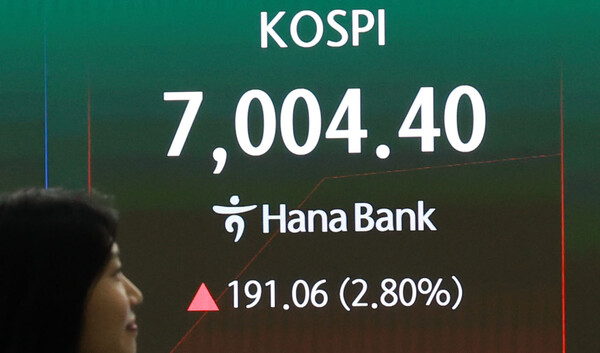
South Korean shares are expected to test this week whether the KOSPI can hold the 7,000 level. As semiconductors regain leadership and gains spread to non-chip sectors, the strength of the rebound is likely to hinge on whether foreign buying continues and on the direction of U.S. long-term interest rates.
The KOSPI ended on Aug. 14 up 164.60 points, or 2.42 percent, at 6,977.94. It rose as high as 7,010.86 during the session, briefly topping 7,000. The Kosdaq closed up 0.38 percent at 864.65. Both indexes extended gains for a fifth straight session.
U.S. stocks edged lower after a mild pullback near record highs. On Aug. 14, the Dow Jones Industrial Average fell 0.20 percent to 53,732.41, the S&P 500 slipped 0.17 percent to 7,785.76 and the Nasdaq dropped 0.28 percent to 26,729.16. Weak U.S. retail sales in July and rising international oil prices and Treasury yields weighed on sentiment.
Still, the overall tone in global equities has been steadier than a month ago. U.S. inflation data did not significantly stoke market concerns, and big tech earnings tied to artificial intelligence investment also remained solid, easing worries about weakening AI demand. The S&P 500 and Nasdaq each extended a three-week winning streak through last week.
In South Korea, semiconductors have again become central to the rebound. Exports in Aug. 1 to 10 totalled $21.3 billion, up 45.3 percent from a year earlier, the highest on record for the early-August period. Semiconductor exports jumped 155.4 percent, lifting their share of total exports to 46.8 percent.
The industry sees semiconductor export and earnings momentum holding up, while supply-demand distortions seen during the earlier sharp selloff have also eased considerably. With trading in related products declining after tighter regulations on single-stock leveraged exchange-traded funds, flows that had been overly concentrated in large semiconductor stocks are viewed as moving toward normalisation.
A shift away from a market where only semiconductors rise is also seen as positive. In the recent rebound, buying spread to non-chip sectors such as construction, machinery, cosmetics and apparel. The industry expects semiconductors to remain at the market’s core while sector rotation continues into non-chip industries that saw larger declines relative to earnings.
The Kosdaq is also cited as having room for a further rebound. It went through a larger price adjustment than big semiconductor stocks in the earlier selloff, and supply-demand conditions could improve as funds that had flowed into single-stock leveraged ETFs become more dispersed.
Foreign flows are seen as the most important variable this week. In past rebounds after sharp KOSPI declines, foreigners tended to maintain net buying for longer than institutions and retail investors.
In particular, with foreigners’ ownership in major semiconductor stocks having fallen versus the past, a shift to sustained net buying could add momentum to the index rebound.
Rising long-term yields remain a risk factor to watch. The U.S. 10-year Treasury yield approached 4.7 percent on Aug. 14. International oil prices also rose as tensions in the Middle East came back into focus, leaving room for inflation and long-term yields to be pushed higher.
If a so-called “rate tantrum” occurs, in which yields surge alongside a stock rebound, volatility could rise again, led by growth stocks and semiconductors.
Investors also need to watch the minutes of the Federal Open Market Committee’s July meeting, due on Aug. 19. The Federal Reserve kept its policy rate unchanged at last month’s meeting, but there were also internal views calling for rate hikes. The minutes will show how hawkish committee members’ views are on inflation and future monetary policy.
Economic indicators including U.S. industrial production on Aug. 18 and purchasing managers indexes for manufacturing and services on Aug. 21 are also due. If the economy is confirmed as not sharply weakening while inflation pressure also stabilises, that would be favourable for equities. If the economy remains strong and inflation concerns rise again, upward pressure on long-term yields could increase.
Ultimately, the quality of the rebound is expected to matter more this week than the act of breaking 7,000 itself. If foreign buying continues and gainers broaden from semiconductors to non-chip sectors and the Kosdaq, that could be seen as another step in normalising flows after the sharp July selloff.
If U.S. long-term yields surge again or foreign flows weaken, the indexes could again show high volatility.
Jong-min Kim (김종민), head research fellow at Samsung Securities, said rates are holding up rather than gradually falling, but if there is no extreme rate tantrum under the current conditions, there is a high chance an relief rally will continue.
Dong-gil Noh (노동길), an analyst at Shinhan Investment, said the key lies in volatility itself. He said confirming full stabilisation of volatility and a fundamentals-led normalisation requires checking whether net outflows from single-stock leveraged products continue.
Jae-won Lee (이재원), an analyst at Yuanta Securities, said a return to sustained net foreign buying is important to extend the KOSPI uptrend. He said there is a need to reduce exposure concentrated in major semiconductor stocks within the sector and increase exposure outside semiconductors.
 Sangyeop Oh
yub@d-today.co.kr
Sangyeop Oh
yub@d-today.co.kr