
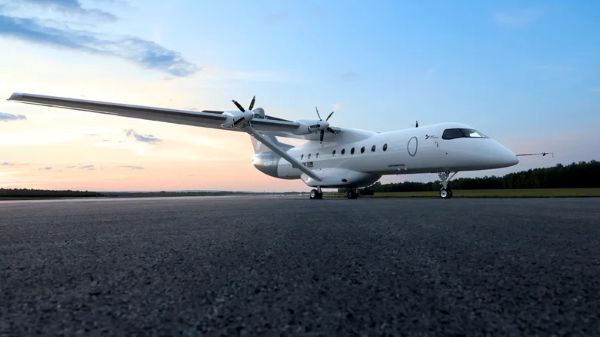
[DigitalToday intern reporter Seung-a Yoo] Global electric aircraft manufacturing startup Heart Aerospace has succeeded in the first flight of its X1 battery-electric aircraft prototype.
According to tech media outlet Engadget on Aug. 13 local time, the X1 took off from Plattsburgh International Airport in upstate New York, flew for 27 minutes and climbed to an altitude of 1,100 feet, or about 340 metres. The entire flight was conducted using only batteries.
The flight is seen as an early milestone in gauging the commercial viability of electric aircraft. Heart Aerospace said the flight required less than $5, or about 7,100 won, in electricity costs, including takeoff and landing. It directly showed the potential to cut operating costs in markets where jet fuel prices are a major burden. Executives at United Airlines and Air Canada also responded positively, showing interest in adding electric aircraft to their fleets.
Heart Aerospace plans to move on from the X1 to develop the ES-30, a 30-seat fixed-wing hybrid aircraft. The ES-30 targets routes serving regional airports. The company expects it can operate short-haul routes more cheaply than turboprop aircraft such as Embraer ERJ jets that currently handle them.
It also presented a range target. The ES-30 is designed to fly 125 miles on pure electric power, and up to 500 miles, or about 800 km, using a hybrid engine. Heart Aerospace does not see its competitiveness as depending only on the price gap between electricity and jet fuel. It says lower maintenance and operating costs for electric motors, and higher reliability, could help improve profitability.
But the operating concept presented by the company also faces challenges. The ES-30 aims to operate with a single pilot at first, then later enable autonomous flight services. That plan requires verification not only of technical maturity but also of the actual operating system.
It set 2031 as the start of service. That is seen as a fairly tight target for an aircraft development timeline. In the electric and next-generation aviation market, multiple companies are already competing with their own approaches. Heart Aerospace will also compete in the next-generation flight market alongside Boom Supersonic, Harbour Air, ZeroAvia and Rolls-Royce.
In the end, the success or failure of commercial electric aircraft depends on battery technology. Batteries with higher energy density and lighter weight than current ones are needed to improve both range and payload efficiency. Against that backdrop, the X1's first flight showed that electric aviation has entered a real airframe development stage, but battery performance and the development schedule are expected to be key variables until the ES-30's commercial operations.
 Seung-a Yoo
ysah@d-today.co.kr
Seung-a Yoo
ysah@d-today.co.kr