
G-Star, the country's largest game exhibition, is expanding beyond a show structure centred on new titles from game studios and large booths to cover content more broadly, including artificial intelligence (AI), webtoons and mobility. The organising committee will also increase programmes it plans itself to supplement a structure in which event content has depended on the lineup of participating game companies.
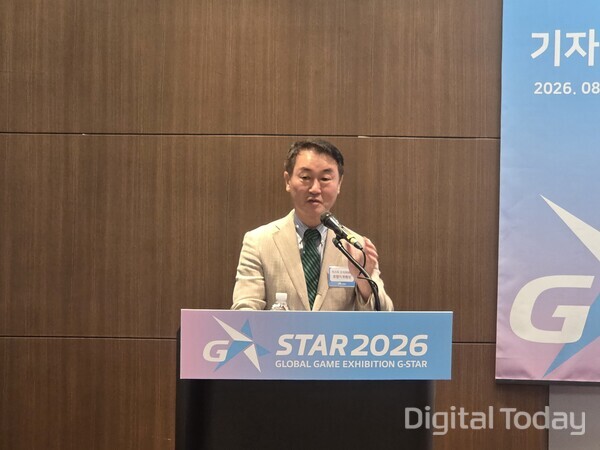
The G-Star organising committee held a press briefing on Aug. 13 at COEX in Seoul. It presented two key strategies for G-Star 2026: "expanding the boundaries of industry and target audience" and "expanding in-house content."
Cho Young-ki (조영기), head of the G-Star organising committee, said this year's G-Star strengthened convergence content that connects with various industries and significantly reinforced in-house content planned and run directly. He said the event will diversify its participating companies and aim to become South Korea's leading platform that offers intrinsic fun and new possibilities to everyone who visits G-Star.
G-Star 2026's BTC event will be held at BEXCO in Busan for four days from Nov. 19 to 22, and its BTB event will run for three days from Nov. 19 to 21.
◆As console blockbuster development cycles lengthen… reducing reliance on game studio participation
The organisers said the push for changes this year reflects structural shifts in the game industry. Jeong Seung-woo (정승우), a director at the G-Star organising committee, said exhibitions by nature show the results of an already completed industry, meaning they essentially follow the market. From that perspective, he said the growing weight of PC and console in the game industry has also lengthened development timelines for major studios' blockbuster titles.
He said that compared with the era when mobile games dominated, most major developers are now focusing on console games. He said producing at least triple-A content requires more resources and has made development timelines and cycles much longer.
He said that if G-Star is assumed to serve as a promotional platform, developers making console games have very limited agendas for participating, at once every 5 years or 7 years. He said exhibitions inevitably are influenced by participants and content tends to be decided by whether strong developers are present. He said increasing in-house content planned by the organisers is intended to supplement this participant-dependent structure.
◆Crack and Hyundai Motor join… expanding into AI, webtoons and mobility
A change symbolising the broader scope is the main sponsor. This year's main sponsor is the AI story creation platform "Crack," operated by Wrtn Technologies. It is the first time a company that does not directly develop or service games has joined G-Star as main sponsor.
Jeong said he sees two key keywords running through the current industry as AI and narrative. He said the organisers judged Crack to be the best partner because it can encompass both AI and narrative.
The organisers said expanding the event's scope is not simply about increasing visitor numbers. Jeong said it does not mean expanding a G-Star that draws 200,000 people to 250,000. He said that while most existing visitors had been limited to gamers, the direction now is to build content that can embrace people who like games, comics and content overall.
In line with that direction, this year's main key visual was produced in collaboration with Lee Dong-gun (이동건), the creator of Naver Webtoon "Yumi's Cells." The event will sell a special pass linked with KREAM that includes related goods, and will also run a G-Star pop-up store from Sept. 1 to 7 at The Hyundai Department Store's Pangyo branch.
The second exhibition hall will focus on programmes linking games with other industries. Hyundai Motor will set up a special booth to host the grand final of the "2026 Hyundai N Virtual Cup," alongside displays of Hyundai N brand high-performance vehicles and race cars and a simulation racing experience. Jeong cited Hyundai's participation this year as a representative example driving content expansion, as expanding the event's scope is one of the biggest strategies.
A new title experience zone in collaboration with Intel will be created at a scale of at least 100 booths. Sega and Koei Tecmo Games will participate and present unreleased titles including Sega Europe Studio's "Total War: Warhammer 40,000."
Indie games will also be expanded as "G-Star Indie Showcase 2.0: GALAXY," covering the broader indie ecosystem with participation from Devolver Digital, Unity, Steam Deck and Discord. Jeong said the organisers judged it important to show the indie ecosystem rather than simply display indie games because G-Star must have its own indie value.
The organisers also increased content produced directly. G-CON 2026 will be held on Nov. 19 and 20 on a single stage with 1,500 seats, and will organise 16 sessions around the theme of "narrative" following last year. Crack will participate as G-CON's first sole main sponsor. Jeong said the concept prepared for this year is based on the idea of game developers asking about good storytelling and film directors answering.
That was also why speakers were not limited to game developers, but included creators from other content fields such as film, webtoons and animation. Speakers include directors Jang Hang-jun (장항준) and Lee Byung-hun (이병헌), Shift Up CEO Kim Hyung-tae (김형태), Mikami Shinji, and "Final Fantasy VII" creators Kitase Yoshinori and Hamaguchi Naoki, as well as CD Projekt Red's Marcin Blacha and other creators in games, film, webtoons and animation.
After lectures, the organisers also created a new free programme called "Roundtable," where creators and participants can share opinions in small groups.
An online new-title showcase will also be newly introduced. Unlike the existing format, such as Summer Game Fest or The Game Awards, which briefly introduces many games, it will focus on a small number of works for longer. Jeong said the existing method of introducing many games through short videos has already become entrenched, and said that as a latecomer the organisers are considering long-form production that can cover about 2 or 3 games in depth in 20 to 30 minute segments. Specific participants and the programme will be announced in September.
The BTB exhibition also more than doubled the size of its business lounge from last year and created new "lounge booths" of about 0.5 booth scale to reduce the participation burden for small developers. An investment market linking venture capital firms, angel investors and publishers will also be operated again.
◆G-Star amid a big-company void… Busan expands beyond BEXCO
Behind these changes is the reality of declining participation by large game companies. The companies announced so far for the first exhibition hall do not include so-called "3N2K" players Nexon, Netmarble, NC, Krafton and Kakao Games. Instead, the list includes Crack as well as Google Play, Webzen, Team42, HoYoverse, NetEase Games, Bilibili Games and Century Games. The final list of participants and the exhibition hall floor plan will be announced in September.
Cho said that large game companies have fewer major new titles they can show at G-Star and various conditions overlap. He said it is important to hold an event that participating companies and visitors can be more satisfied with, rather than an event divided into a binary focus on how many large domestic game companies participated and how many overseas game companies participated.
He added that compared with overseas game shows such as Gamescom and ChinaJoy, there are limitations in physical conditions such as exhibition space scale. He said it is important to grow G-Star into a global event by emphasising its own differentiation rather than competing on size.
G-Star's expansion beyond its traditional scope will also continue outside BEXCO. The Busan city government plans to connect the event from major gateways such as Busan Station and Gimhae Airport to Centum City Station and tourist sites, turning the entire city into a game festival space during G-Star. Hwang Jeong-sun (황정순), head of Busan city's Visual Content Industry Division, said the main event is held at BEXCO, but the city aims to make not only the main venue but all of Busan a space for a game festival together with G-Star.
The city will set up G-Star-related spaces and promotional materials at Busan Station and Gimhae Airport. At Centum City Station, which connects to BEXCO, it will prepare a G-Star themed space and urban railway tickets using G-Star intellectual property. It will also prepare tourism passes for visitors, lodging and tourism-linked promotions, and an AI interpretation guidance service for foreign visitors. It will also 추진 a special drone show in Gwangalli themed around G-Star during the event period.
During the event, it will expand transportation support such as additional urban railway services and bus routes, and will also conduct guidance and campaigns to stabilise accommodation rates. Hwang said police and fire authorities will prioritise safety responses during G-Star, and the city is concentrating administrative capacity on safety management such as operating medical centres and controlling major arterial roads.
On Nov. 18, the day before the opening, the Korea Game Awards ceremony will be held. A press kit containing a detailed list of participating companies, the exhibition hall floor plan and G-CON's full speaker lineup will be released in September.
Through these changes, the organisers plan to break from a structure that has been swayed by whether specific game companies unveil new titles and by booth size, and to broaden G-Star's scope as an event connecting AI, webtoons, mobility and creator content around games.
 Lee Ho-jung
lhj@d-today.co.kr
Lee Ho-jung
lhj@d-today.co.kr