
As tougher delisting requirements aimed at weeding out weak companies take effect in South Korea's stock market, 36 so-called penny stocks priced below 1,000 won and issues that fall short of market capitalisation standards were designated as watchlist names in a batch.
The Korea Exchange said on Tuesday that as of the close, 36 issues whose share prices stayed below 1,000 won over the past 30 trading sessions or failed to meet market capitalisation standards for maintaining listings were designated as watchlist names.
A total of 24 issues were designated as watchlist names because their share prices were below 1,000 won. They included 3 on the main board and 21 on KOSDAQ.
A total of 9 issues became watchlist names after their market capitalisation consistently fell below the standard, though they did not meet the share price condition. They included 5 on the main board and 4 on KOSDAQ.
The market capitalisation standard for maintaining listings is 30 billion won for the main board and 20 billion won for KOSDAQ.
Three issues were counted as having both a share price below 1,000 won for 30 consecutive trading sessions and failing to meet the market capitalisation standard. They included 1 on the main board and 2 on KOSDAQ.
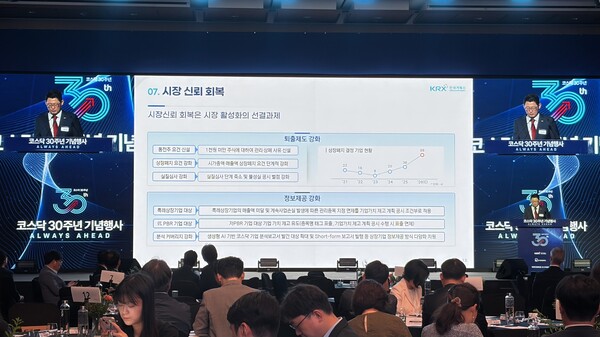
The measure follows a revised listing rules amendment that took effect from the first of last month. The exchange strengthened listing maintenance requirements based on share price and market capitalisation to speed the exit of weak companies from the market.
Under the revised rules, a stock is designated as a watchlist name if its share price stays below 1,000 won for 30 consecutive trading sessions or its market capitalisation falls below market-specific standards.
If it fails to restore the requirements even after being designated a watchlist name, it enters delisting procedures. It then becomes subject to final delisting if it fails to stay above the standards for at least 45 consecutive trading sessions during the subsequent 90 trading sessions.
The large-scale watchlist designation is drawing attention as the first case to emerge as the strengthened listing maintenance standards are applied to the market. Pressure to delist is expected to grow further, centred on low-priced and low market capitalisation issues.
 Sangyeop Oh
yub@d-today.co.kr
Sangyeop Oh
yub@d-today.co.kr