
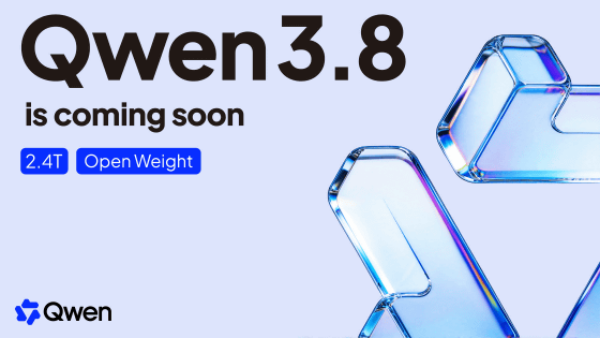
Alibaba is pushing a plan that would require companies using its next open AI model, Qwen3.8-Max, for large-scale commercial purposes to share part of their revenue, online media outlet Gigazine reported on Tuesday.
Alibaba is considering releasing the model as an open model with open weights, while attaching a separate revenue-sharing obligation for large commercial users.
The core is a structure that combines open release with commercial charging. Unlike a typical open-model release, businesses operating services above a certain scale are likely to sign a separate contract with Alibaba and share part of their revenue. Alibaba has not finalised a specific revenue-sharing ratio.
The Qwen series has been released in different ways by generation. Qwen3.5 and Qwen3.6 were released as open models, and Qwen3.7 was released as a closed model. Alibaba has since signalled it will switch Qwen3.8 back to an open model. The policy is seen as an attempt to keep the release strategy in place while adding separate monetisation for large customers’ commercial use.
A precedent Alibaba referenced is already available in China. Chinese AI company Moonshot AI released Kimi-K3 as an open model while applying the Kimi K3 License. The licence requires service providers using the model to sign a commercial contract with Moonshot AI if their annual revenue exceeds $20 million. Alibaba appears to be following a similar framework.
Moonshot AI’s terms are being cited as a reference for gauging the breadth of revenue sharing. The Kimi K3 License was reported to potentially require revenue sharing of up to 30 percent, but details were not disclosed. Alibaba has also not decided what level of ratio it will apply.
The structure shows that monetisation methods are changing even within the open-model ecosystem. Even if model weights are 공개, it could become more common to require separate contracts for businesses that use them in large-scale commercial services. In particular, if a large model such as Qwen3.8-Max is used as core infrastructure for enterprise services, licence terms could directly affect the development ecosystem and adoption costs.
Key points to watch include where Alibaba sets the threshold for large commercial users and how specifically it will spell out the revenue-sharing ratio and contract terms. With Qwen3.8 set to be released again as an open model, drawing the boundary between the scope of release and conditions for commercial use is expected to emerge as a key market variable.
 Jinju Hong
hongjj@d-today.co.kr
Jinju Hong
hongjj@d-today.co.kr