
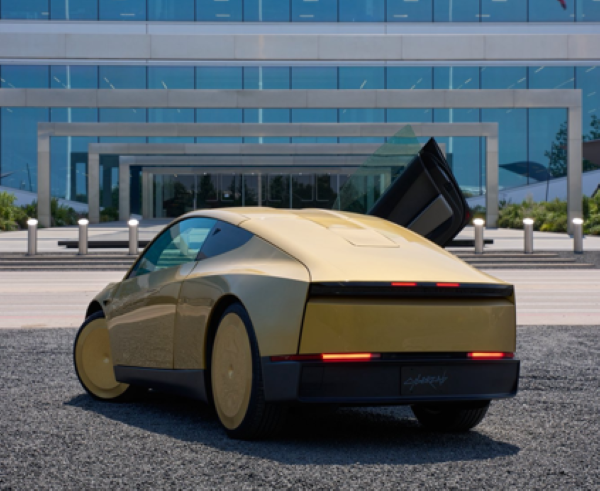
Tesla has unveiled the first physical Cybercab with a Starlink antenna integrated into the vehicle.
Electrek reported on Aug. 10, local time, that Tesla Robotaxi’s official account posted two photos of a gold Cybercab parked at Gigafactory Texas, calling it the first Cybercab with Starlink integration.
The vehicle shown has a flat satellite antenna mounted on the roof. One photo shows the front side of the car with its door raised upward, with the U.S. flag and the Texas state flag in the background. The other shows the roof antenna and a rear “Cybercab” badge. Tesla posted only the photos and a short line, and did not explain specifications, rollout timing or the antenna’s specific purpose.
The reveal follows Tesla and Starlink saying in July that they had “directly integrated” satellite internet into the Cybercab. At the time, they released only renderings showing the interior structure, but this time the hardware mounted on the vehicle is visible.
Its purpose remains unclear. The Cybercab is designed to drive autonomously using Tesla’s AI4 onboard computer, so an internet connection is not essential for driving itself. Areas where the robotaxi service currently operates include Austin, Houston, Dallas and Miami, which are urban markets with dense mobile networks. That is an environment where satellite communications are least needed. Tesla described it as an “additional connectivity option to track robotaxis in remote areas.”
The impact on the cost structure is also in focus. The Cybercab is a two-seat robotaxi unveiled in October 2024, and Tesla has aimed for a price of about $30,000 by removing the steering wheel and pedals. Adding a satellite antenna increases costs, weight and communications fee burdens. With driving computation handled by the in-car computer and existing mobile networks in cities enabling remote monitoring and support, some have pointed out it could become redundant equipment.
Production began earlier this year at Gigafactory Texas, and more than 100 vehicles were spotted on the factory site through July. But it has not moved into the commercialization stage. Tesla still cannot sell or operate the vehicle without human supervision. That means service expansion or sales timing is not automatically set even if production of physical vehicles proceeds.
Ultimately, the significance of the reveal is that Tesla has moved the Cybercab-Starlink combination from renderings to a physical vehicle. With no use case disclosed, the next point to watch is whether satellite communications are advance preparation aimed at expanding autonomous driving between rural and urban areas, or part of the current robotaxi operating system.
First Cybercab with @Starlink integration pic.twitter.com/8TI6LYSFjl
 Seung-a Yoo
ysah@d-today.co.kr
Seung-a Yoo
ysah@d-today.co.kr