
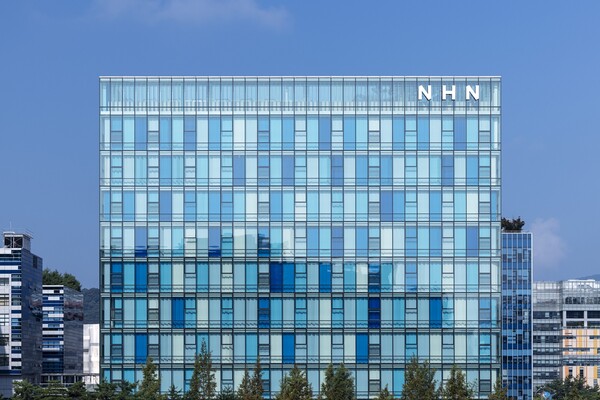
NHN is accelerating its growth strategy centred on its artificial intelligence (AI) GPU business. After laying a profit foundation through business efficiency and cost controls through last year, it plans to expand data centres and the latest GPU infrastructure, secure overseas customers and grow the AI infrastructure business into a new growth axis.
In games, it will concentrate new title development capabilities on the Japanese market. In payments, it will advance stablecoin payment and settlement infrastructure based on its existing payment gateway merchant network.
NHN said on Monday it posted second-quarter consolidated revenue of 757.9 billion won and operating profit of 57.9 billion won. That was up 25.3 percent and 164.1 percent, respectively, from a year earlier, and both revenue and operating profit were quarterly records. Game revenue was 139.6 billion won, payments 394.0 billion won and technology 159.8 billion won, up 21.5 percent, 27.3 percent and 52.9 percent, respectively.
Chief Executive Jung Woo-jin (정우진) said on an earnings conference call that the results of management efficiency and cost controls over the past few years began to be reflected in performance from the fourth quarter of last year. He said this year is a period when the performance of major businesses is coming into full swing on that foundation. He said the second-quarter results were the first quarter in which the outcome was confirmed in profit.
Chief Financial Officer Ahn Hyun-sik (안현식) also said it had built a business structure in which all major businesses can generate profit, rather than a temporary performance improvement dependent on a specific business or seasonality.
AI GPU demand drives early infrastructure 확보; targets overseas customers too
The performance was driven by NHN Cloud’s AI GPU business. As the supply of Nvidia B200-based GPU-as-a-service at the Seoul Yangpyeong region, which began operations at the end of March, ramped up from the second quarter, NHN Cloud revenue rose 85.3 percent from a year earlier.
New long-term contracts are also being discussed for the remaining capacity at the Yangpyeong region. Jung said discussions on new long-term contracts for the remaining portion are under way, boosting revenue visibility further. He said a more positive revenue trend than initially expected will continue from next year.
Ahn added that not all contracts have been completed. He said operating profit could fluctuate depending on the pace and duration of contract signings.
To meet rising demand, NHN Cloud plans to secure at least 30 megawatts (MW) of additional AI data centre capacity by next year and expand existing regions with the latest GPUs of B300 or higher.
NHN Cloud CEO Kim Dong-hoon (김동훈) said it is preparing 20 MW through leases and 10 MW through its own centre, targeting the second half of next year. He said total capacity would be similar to the combined scale of the current Yangpyeong, Pangyo and Gwangju regions.
It is also expanding its business scope from the domestic market to overseas. Kim said the GPU business is being prepared with overseas as the target rather than South Korea. He said demand from overseas companies has recently increased and some customers are expected to sign contracts soon. He said it is also securing a data centre in Japan to prepare to expand services for global customers.
Kim said its AI full-stack brand, 'FactoryX', unveiled in May, differentiates it from providers that simply supply GPUs. He said it plans to expand into a provider that supports companies' AI transformation, offering everything from securing GPU infrastructure and optimising operations to an execution environment for AI agents.
The timing of an initial public offering for NHN Cloud remains flexible. Ahn said it is continuing discussions with financial investor IMM, but it is hard to be definitive because shareholder consent is needed. He said it will be able to provide a specific answer when the GPU business is more fully under way and sufficient operating profit has been secured.
Games focus on Japan; payments expand into stablecoins
A new title, 'Puchi Poyong of the Fantasy World', being developed in collaboration between NHN’s games division and Japan’s NHN PlayArt, is targeted for release this winter. NHN PlayArt will participate in the Tokyo Game Show in September and unveil its lineup including the new title.
Total second-quarter web board game revenue rose 15 percent from a year earlier. NHN is expanding its user base and brand awareness through an offline tournament, 'HPT', based on 'Hangame Royal Hold’em', and held the fourth event in July. In Japanese mobile games, 'Compass' increased revenue 105 percent from the previous quarter through a collaboration with the anime 'Chainsaw Man'.
In payments, it will expand NHN KCP’s merchant base into stablecoins. NHN KCP’s second-quarter transaction value was 17 trillion won, up 34 percent from a year earlier, and its domestic payment gateway market share was about 30 percent, up 2 percentage points from the previous quarter.
NHN KCP completed a proof of concept (PoC) for employees using a mainnet co-developed with global blockchain company Avalanche. At a demo day in late July, it demonstrated stablecoin payments and merchant settlement by combining a digital wallet with the NHN Payco app.
Net profit was 29.1 billion won, up 158.8 percent from a year earlier, but down 6.6 percent from the previous quarter. Ahn said it was not so much that financial costs increased as that financial income declined. He said it reflected a base effect from disposal and valuation gains from the sale of investment assets in the first quarter.
NHN expects the profitability trend in its games, payments and technology businesses to continue in the second half.
Ahn said the trend will be maintained within this year. He said other segments are still in the red, but it is reducing losses through efficiency measures.
Future performance is expected to depend on whether it can link AI GPU demand to long-term contracts and overseas revenue and grow follow-on businesses such as new titles in Japan and stablecoins into growth drivers.
 Hojeong Lee
lhj@d-today.co.kr
Hojeong Lee
lhj@d-today.co.kr