
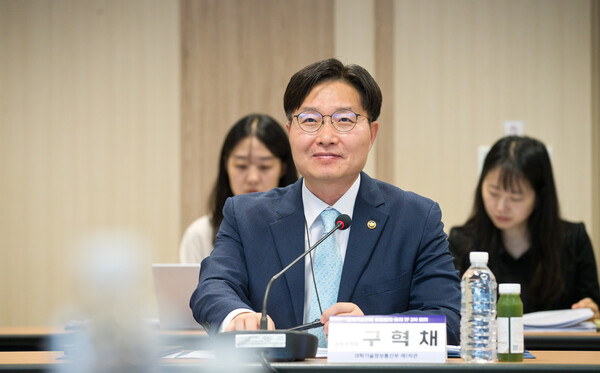
South Korea's Ministry of Science and ICT said on Monday it will hold a launch ceremony for the "Self-Driving Lab Industry-Academia-Research Council" at the L Tower in Seoul.
A self-driving lab (Self-Driving Lab, SDL) is a research platform that links experimental equipment, robots and AI to automatically repeat experiments. The ministry said it enables 24-hour continuous experiments and exploration of multiple experimental conditions, shortening research periods and improving reproducibility.
The government sees self-driving labs as a key foundation for K-Moonshot, a national project to boost research productivity using AI. Under the plan, AI generates hypotheses, self-driving labs verify them, and AI learns again from the results, building a closed-loop system of "hypothesis-experiment-analysis-rehypothesis."
The council will be run as an industry-academia-research cooperation platform to discuss technology development related to self-driving labs, joint use of infrastructure, data accumulation, establishment of standards and interfaces, and demonstration and dissemination.
Professor Yoo-sung Jeong (정유성) of Seoul National University will serve as chair. The National AI Science Research Center (NAIS) and the Korea Basic Science Institute (KBSI) will serve as joint secretariats. Participants include 50 supplier and user companies such as Park Systems, HB Solution, Samsung Advanced Institute of Technology and SK hynix, as well as about 30 universities and research institutes.
The council will operate mainly through three subcommittees: technology, platform and standards; research and operations; and demonstration and dissemination. It plans quarterly plenary meetings and working-level meetings by subcommittee, and will share related results and policy and technology trends through an annual industry-academia-research forum.
Gu Hyeok-chae (구혁채), first vice minister of the science ministry, said, "Self-driving labs are key infrastructure supporting national missions such as K-Moonshot." He added, "We will provide policy and institutional support so the government, government-funded research institutes, universities and industry can build a domestic self-driving lab ecosystem together."
 Seul-gi Son
sageson@d-today.co.kr
Seul-gi Son
sageson@d-today.co.kr