
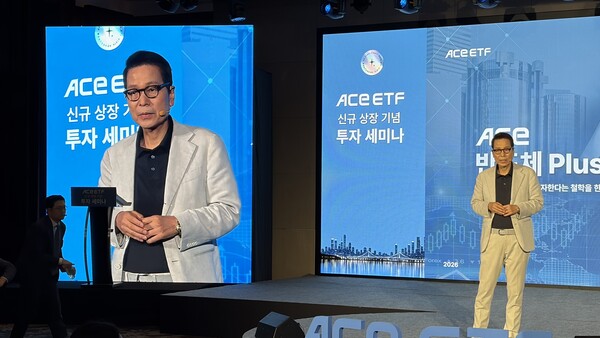
Bae Jae-kyu (배재규), chief executive of Korea Investment Trust Management and dubbed the "father of ETFs", said investors should put money into growth industries for the long term rather than single-stock leveraged exchange-traded funds. He reiterated his investment philosophy that direction and time matter more than short-term trading, after arguing last month for the "natural death" of single-stock leveraged products.
Speaking at a seminar marking the new listing of the ACE SemiconductorPlus Strategic Industries ETF at Conrad Seoul in Yeouido, Seoul, on Aug. 10, Bae said, "To succeed in investing, you need both direction and time." He said investors should set a direction and invest time, rather than repeatedly making market forecasts and predictions.
He explained that deciding an investment direction is a matter of logic, but enduring the volatility after investing is a matter of emotion. That means investors should choose industries expected to grow over the long term and benefit from compounding, rather than repeatedly trading by predicting short-term price moves.
Bae said, "Do not invest in cheap stocks, short-term trading, or leveraged ETFs. Invest long term in tech companies using new technologies." He said he hopes investors invest time rather than wasting it by buying and selling repeatedly.
While saying he would refrain from further comments on single-stock leveraged ETFs, he maintained his position. "I had a very hard time because of the leverage talk," he said. "From now on, I will only talk about leverage to this extent, and please do not ask related questions."
On July 20, Bae posted on his Facebook page, then deleted it, saying, "Do not invest in individual-stock leverage and 2x inverse ETFs," and "I hope you stop investing even now." The remarks drew attention because Korea Investment Trust Management directly manages "ACE Samsung Electronics Single-Stock Leverage" and "ACE SK Hynix Single-Stock Leverage."
On July 30, he said it was "best not to do" single-stock leveraged products and argued they should be allowed to die naturally rather than be forcibly delisted. He meant that instead of leaving it solely to investor choice, the product size should naturally shrink through support from asset managers, liquidity providers (LPs) and institutional measures.
Bae has pointed out that single-stock leveraged products track twice the underlying asset's daily return, increasing volatility. He said if gains and losses repeat, daily rebalancing and compounding can rapidly erode value. Even if the underlying price recovers to its previous level, the leveraged ETF price may not return to its original level, he said.
After financial regulators tightened rules, there was also a numerical cooling effect. The market capitalisation of 16 single-stock leveraged and inverse products surged to 11.9 trillion won as of July 15 from 4.4 trillion won at their listings on May 27. Financial authorities temporarily halted new product listings and advertising and raised the basic deposit required for individual retail investors to 30 million won in cash from 10 million won from July 31.
On Aug. 5, just 4 trading days after the rules took effect, the daily trading value of the 16 single-stock leveraged and inverse products was tallied at 919.8 billion won, falling below 1 trillion won for the first time since listing. The trading scale, which averaged in the 12 trillion won range last month, shrank rapidly.
Bae presented five strategic industries as investment targets contrasted with focusing on a single stock: semiconductors, autos, shipbuilding, defence and nuclear power. He said they share common features such as requiring massive capital and long periods of technological accumulation, and having competitive industrial ecosystems formed in South Korea.
Korea Investment Trust Management will list the ACE SemiconductorPlus Strategic Industries ETF on Aug. 11 reflecting this strategy. The product diversifies investments in companies related to shipbuilding, defence, nuclear power and autos, centred on semiconductors.
Bae said, "Investing in competitive growth industries is investing in Korea's future." He said if investment targets align with long-term trends in the world, investors should endure volatility and invest time.
 Oh Sang-yup
yub@d-today.co.kr
Oh Sang-yup
yub@d-today.co.kr