
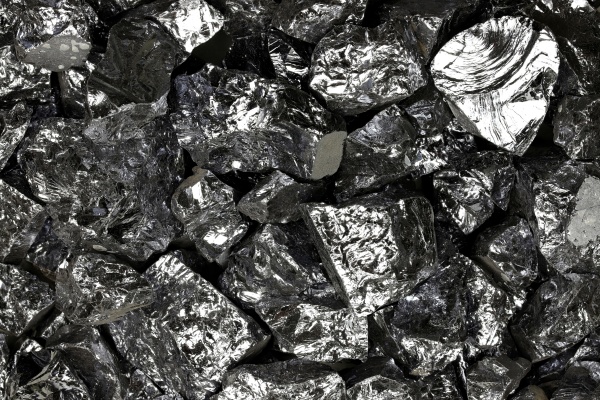
The United States will introduce minimum import prices and a 15 percent tariff targeting polysilicon, a key material in semiconductor and solar supply chains. The move is seen as aimed at shaking up a China-dominated materials supply chain and strengthening U.S. solar and semiconductor production.
Bloomberg reported on Aug. 7 that U.S. President Donald Trump decided to apply new trade protection measures to polysilicon and related derivative products under Section 232 of the Trade Expansion Act.
Polysilicon is an ultra-high-purity silicon material and a starting point for making solar panels and semiconductors. In the solar industry, polysilicon is processed into ingots and wafers, then made into cells and modules. Semiconductors are also manufactured based on high-purity silicon.
Under the measure, the United States will set minimum import prices for polysilicon and major derivative products. A White House document set a minimum import price of $21 per kg for polysilicon and $100 per kg for polysilicon ingots and wafers. Minimum import prices are set at $0.22 per watt for solar cells and $0.38 per watt for solar modules. A 15 percent tariff will be added. The new trade protections are due to take effect on Dec. 4.
The U.S. government also plans to encourage expansion of domestic production facilities rather than stopping at import restrictions. The White House allowed the Commerce Department to create an incentive program to support companies investing in polysilicon and related product manufacturing facilities.
The United States is directly targeting the polysilicon supply chain to reduce dependence on China. Polysilicon is cited as an area where China has particularly strong influence in the solar supply chain. The U.S. government is seen as seeking to bring upstream parts of the supply chain into the country by raising import barriers while providing incentives to invest in domestic production.
Some in the U.S. solar industry welcomed the measures. T1 Energy, First Solar and Qcells, Hanwha's U.S. solar business, positively assessed the policy. T1 Energy Chief Executive Dan Barcelo (댄 바르셀로) called it a decisive step supporting investment in U.S. advanced manufacturing and domestic energy supply chains. T1 Energy is investing $510 million in cell production facilities after operating a solar panel factory in Texas.
U.S. polysilicon producers also responded positively. Hemlock Semiconductor, a joint venture between Corning and Japan's Shin-Etsu Handotai, operates a production facility in Michigan. Corning said the decision would help drive continued investment in U.S. production capacity and improve long-term competitiveness.
Germany's Wacker Chemie also operates a polysilicon production facility in Tennessee. The company said it was reviewing the specific impact of the measures, while praising the fact that the U.S. government continues to address related issues in terms of semiconductor supply chain resilience, advanced computing infrastructure, and defence and security.
The measures are also linked to structural vulnerabilities in U.S. solar manufacturing. The U.S. solar industry expanded its production base after Congress introduced tax incentives in 2022, but growth focused mainly on the final stage of panel assembly. Production in upstream and midstream stages such as wafers and cells still depends heavily on imports.
The U.S. solar industry has argued that over the past decade Chinese companies, backed by government subsidies, supplied products at low prices, undermining the competitiveness of U.S. firms. Critics also raised claims that Chinese companies moved production facilities to other regions such as Southeast Asia to avoid existing U.S. tariffs.
The semiconductor supply chain is also an important backdrop to the measures. The Semiconductor Industry Association said the semiconductor industry's share of global polysilicon demand is only about 2.4 percent. That is interpreted to mean that maintaining a U.S. polysilicon production base for semiconductors requires large demand from the solar industry. It also says semiconductors and solar should be approached not as separate industries but as a single silicon supply chain.
Still, with implementation set for December, some voices are raising concerns about short-term side effects. Lawyer Tim Brightbill (팀 브라이트빌), who has pursued multiple trade cases against Chinese solar companies, raised the possibility that imports could surge before the tariff and minimum import prices take effect. In contrast, there is also an assessment that companies buying solar panels need time to adjust supply contracts to the new price structure.
There are reports that polysilicon production facilities in the United States are currently limited to two sites. That makes it a key variable how quickly the U.S. government can expand the domestic production base by using import barriers and investment incentives at the same time.
Ultimately, the measures can be seen as a move to bring into the United States a silicon supply chain that has depended on China, beyond a simple tariff on solar products. A key point to watch will be whether the United States can raise self-sufficiency across the supply chain from polysilicon to ingots, wafers and cells, and whether the policy leads to investment in U.S. semiconductor and solar production facilities.
 Jinju Hong
hongjj@d-today.co.kr
Jinju Hong
hongjj@d-today.co.kr