
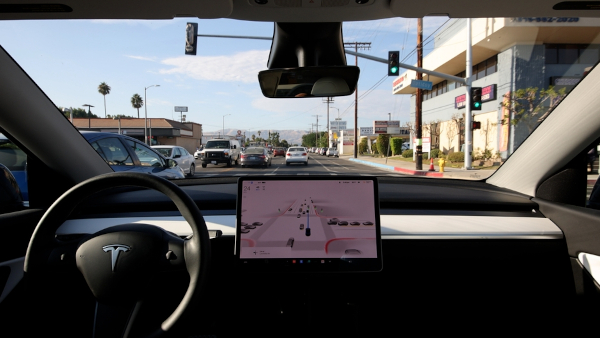
[DigitalToday reporter Jinju Hong] Tesla’s latest FSD (Full Self-Driving) software is shown to have significantly increased reaction speed to unexpected situations even on the same in-car computer. The latest hardware, HW4, showed the fastest performance, but results also showed reaction times improved by more than 30 percent on older HW3 through a software update alone.
On Aug. 7 local time, electric vehicle outlet InsideEVs reported that YouTuber TechGeek Tesla compared reaction times to an unexpected pedestrian situation using three Tesla vehicles running different combinations of hardware and FSD software.
The test was conducted on the same route, speed and conditions. As a vehicle approached a certain point at 23 miles per hour (about 37 km per hour), a pulley device installed by the roadside pulled a human-shaped dummy into the vehicle’s path. The test measured the time it took for the vehicle to recognise and respond to the unexpected situation.
The comparison covered two HW3 vehicles and one HW4 vehicle. The HW3 vehicles ran FSD v12.6.4 and FSD v14 Lite, respectively, while the HW4 vehicle used FSD v14.3.4.
The fastest response came from the HW4 and FSD v14.3.4 combination. Reaction time was measured at 0.450 seconds. The HW3 vehicle using FSD v14 Lite recorded 0.675 seconds, while the HW3 vehicle using older FSD v12.6.4 took 1.065 seconds.
The HW4 vehicle’s reaction time was about 57.8 percent shorter than the HW3 vehicle running older FSD v12.6.4. Even on the same HW3, the vehicle with FSD v14 Lite responded about 36.6 percent faster than the HW3 vehicle with older FSD v12.6.4.
This was a particularly notable point in the test. A significant difference emerged in reaction time even without replacing the in-car computer from HW3 to HW4, solely due to the software version.
The HW3 vehicle with FSD v14 Lite was also slower than the HW4 vehicle with FSD v14.3.4. But it responded about 0.39 seconds faster than the HW3 vehicle using older software. That is an improvement of about 36.6 percent.
InsideEVs assessed that it was an expected result that the HW4 vehicle showed the best performance, but said the comparison shows FSD performance is not determined only by hardware. It is difficult to evaluate Tesla FSD’s overall self-driving performance based on this single test. It is also not possible to judge automatic emergency braking or the safety of autonomous driving systems by a single reaction time.
Still, the time it takes to recognise an unexpected situation and proceed to braking or an avoidance decision is one of the important performance indicators for an autonomous driving system. As reaction time shortens, the amount of leeway to respond in unexpected situations increases.
The results also align with why Tesla is focusing on optimising FSD software. As reaction time fell sharply through software updates even on the same HW3 vehicles, how much performance can be lifted for existing vehicles could become an important variable in FSD competitiveness going forward.
Tesla is also stepping up efforts to improve hardware performance. It is pursuing a plan to double the memory capacity of the new HW4 platform, and its next-generation AI5 chip is also aiming for much higher computing performance than existing systems.
More powerful computing resources provide the basis for running complex AI inference models in a vehicle. This could affect not only recognising maps or the surrounding environment, but also judging driving situations that occur in the moment more quickly.
Ultimately, improvements in Tesla FSD performance are likely to proceed simultaneously on two fronts, hardware and software. If the latest HW4 and next-generation AI chips play a role in increasing physical computing capability, software updates become the factor that determines how efficiently the available hardware performance can be drawn out even in existing vehicles.
As results like this test show reaction time can be significantly reduced through software alone even on older HW3, it appears that evaluating Tesla FSD performance in the future will require looking not only at a vehicle’s chip and sensors but also which FSD version is applied.
 Jinju Hong
hongjj@d-today.co.kr
Jinju Hong
hongjj@d-today.co.kr