
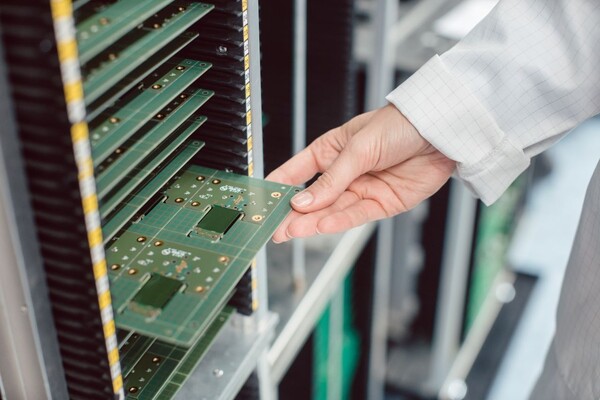
Expanding investment in artificial intelligence (AI) infrastructure is spreading supply shortages from high-bandwidth memory (HBM) to printed circuit boards (PCBs). Global PC makers such as HP and Dell are having difficulty securing the volume of boards needed for 2027 product production.
On Nov. 12 (local time), IT media outlet TechRadar reported that order lead times at some PCB suppliers have extended to as long as 30 months.
PCBs for AI servers are more demanding to produce than boards for general PCs. German electronic components company Wuerth Elektronik analysed that AI server PCBs have 3 to 5 times more layers than general products and use low-loss laminates and special glass fibre. It explained that manufacturers' production capacity is being depleted quickly because more materials and production time are required.
PCB companies are focusing production capabilities on higher-margin products for AI servers. Market research firm in4ma reported that in July some manufacturers notified existing customers that they would stop producing standard boards and focus on AI server products. Amazon also moved to secure its supply chain in September by investing about 1590 million Taiwan dollars (about 65 billion won) in Taiwan PCB maker Gold Circuit Electronics.
The situation for PC makers has become more complicated. An executive at a U.S. PC company told the Nikkei that the company is having difficulty securing the necessary PCB volume even though it expects shipments to decline again next year.
IDC said global PC shipments in the third quarter this year fell 20.1 percent from a year earlier to 62.7 million units. HP and Dell shipments also fell 30.9 percent and 25 percent, respectively. IDC explained that the decline was affected by distributors running down inventories secured earlier in the year ahead of price increases. The fact that boards are hard to secure even as PC shipments fall shows that supply allocation issues, in which production volume is prioritised for AI server companies, are at work rather than a simple increase in demand.
The PCB supply shortage has worsened this year. German PCB company ILFA said in March that lead times for standard FR-4 laminate extended from a few days to about 4 weeks. In April, a Broadcom executive told the Nikkei that PCB lead times had increased from 6 weeks to 6 months. The 30-month figure cited this time is not an industry average but a number from an anonymous supplier describing some order cases.
Supplies of materials and production equipment have also emerged as bottlenecks. UniMicron chairman S.C. Chien (치엔) said last month at Taiwan's TPCA exhibition that lead times for some core production equipment have reached up to 30 months and waiting periods have lengthened for more than 80 percent of equipment. He warned that low-thermal-expansion glass fibre, copper clad laminate (CCL) and ABF substrate materials could be about 20 percent short of 2027 demand. The Nikkei reported that orders at one major laminate supplier are full through 2030, but this should be distinguished from actual delivery schedules.
It is difficult to conclude that a PCB shortage will immediately lead to a sharp rise in PC prices. Boards account for a small share of laptop manufacturing costs, and companies have not presented specific estimates of the impact on retail prices. Memory semiconductors remain a bigger cost variable. Still, as major PC companies have flagged 15 to 20 percent price increases from the second half of 2026, the PCB supply shortage is adding to component cost burdens.
Small and mid-sized motherboard and graphics card companies with weaker bargaining power are likely to be hit harder than large PC makers that have signed long-term supply contracts. These companies may respond to the supply shortage by raising prices for 2027 products or lowering specifications.
 Seung-a Yoo
ysah@d-today.co.kr