
A proposal said South Korea should simultaneously push to raise the value of undervalued companies, overhaul the Kosdaq market structure and expand demand for long-term investment to help the stock market make an additional leap. Semiconductor-led share gains have been large, but the market needs its structure changed for a broader re-rating and inflows of institutional and long-term funds, it said.
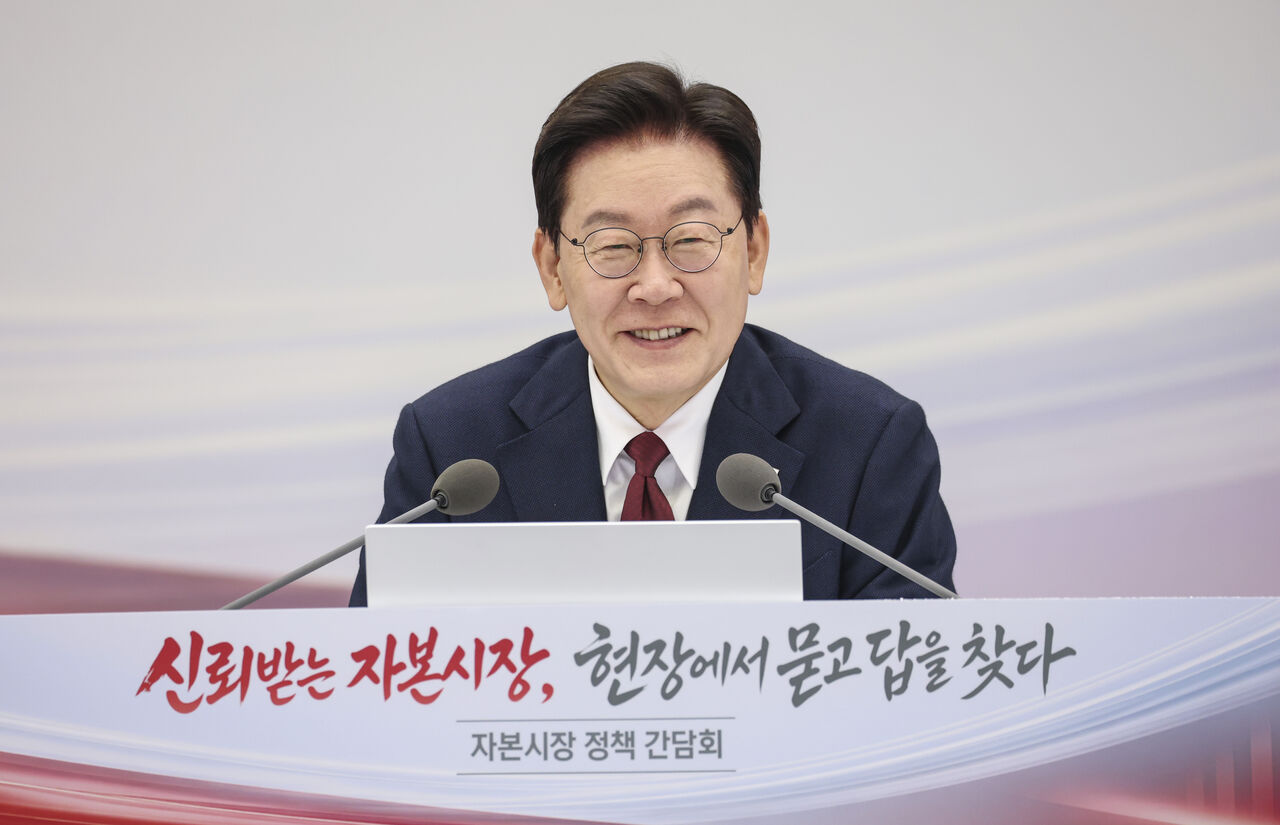
At a capital markets policy meeting chaired by President Lee Jae-myung (이재명) on Nov. 13 at the Korea Exchange in Yeouido, Seoul, Lee Hyo-seop (이효섭) of the Korea Capital Market Institute, Lim Hyung-jun (임형준) of the Korea Institute of Finance and Shin Young Securities research head Kim Hak-kyun (김학균) each presented ways to boost corporate value, redesign the Kosdaq market and expand the stock market's long-term demand base.
Lee Hyo-seop said the South Korean stock market has recently moved out of its past undervaluation range, but he assessed there is room for further gains compared with major countries.
According to Lee, KOSPI's price-to-book ratio broke out of a long-term range of 0.8 to 1.2 times over 2015 to 2024 and has risen since last year, but it stood at 1.74 times as of last month, below the United States at 5.67 times, Taiwan at 5.55 times and Japan at 2.03 times. Among KOSPI-listed companies, 560 firms had a PBR below 1, and 877 firms on Kosdaq were in the same category, it said.
Corporate profitability and shareholder returns have improved, but governance issues were still cited as a factor limiting gains in corporate value. Return on equity rose to 9.5 percent from 5.2 percent over 2023 to 2025, while cash dividends increased to 56 trillion won from 43 trillion won and treasury share cancellations rose to 21 trillion won from 5 trillion won.
Lee presented steps including disclosures by low-PBR firms, expanded shareholder engagement by institutional investors, normalisation of the mergers and acquisitions market and selective taxation of firms that intentionally suppress share prices.
He particularly said minority shareholder rights should be expanded during M&A by shifting merger prices away from a market-price focus to fair value and external valuation methods and by strengthening disclosure in the acquisition proposal process.
Another diagnosis said the Kosdaq market has expanded listings without comparable progress in forcing out weak firms or increasing institutional investment participation.
According to Lim Hyung-jun, 1,353 companies entered Kosdaq over the past 20 years, while 415 were delisted. The share of marginal firms on Kosdaq rose to 32.6 percent last year from 13.1 percent in 2017. The number of companies with a market capitalisation of less than 30 billion won reached 392.
Retail investors accounted for 73.8 percent of Kosdaq trading last year, and turnover stood at 442 percent, far above KOSPI's 117 percent. The analysis said limited inflows of institutional and long-term funds are lowering both valuation and trust in the market.
The overly heavy concentration of venture capital investment exits in initial public offerings was also cited as a problem.
IPOs accounted for 37.3 percent of exit methods for South Korean venture capital, higher than 4.7 percent in the United States and 9.0 percent in Europe. By contrast, the average time from founding to IPO for South Korean companies was 14.4 years, longer than the 7 to 8-year lifespan of VC funds, meaning investors have little choice but to demand early listings, it said.
Performance after listing was also weak. The median stock price change 12 months after listing for newly listed Kosdaq companies from January 2016 to September 2025 was minus 17.1 percent. Firms listed under the technology assessment special listing track posted minus 20.6 percent, while business model special listing firms recorded minus 51.6 percent.
Lim proposed improving the IPO-dependent exit structure by activating corporate M&A and the VC secondary market, and reviewing the introduction of market segments within Kosdaq to distinguish strong, high-growth firms from vulnerable firms.
He proposed inducing inflows of institutional and foreign funds so strong companies can stay on Kosdaq, while applying an upgrade-downgrade system to a lower segment. He added that a stigma effect for lower-tier firms and potential harm to newly listed companies should also be considered.
A separate proposal said the investment base should be expanded to supply long-term funds to the South Korean stock market.
According to Kim Hak-kyun, individuals were net buyers of 95 trillion won in the domestic stock market through the 6th this year, while foreigners were net sellers of 217 trillion won. Major institutions including investment trusts, pension funds, insurers and banks also recorded net selling.
Individual investor funds increased sharply. Household funds flowing into the domestic stock market through the 5th this year totalled 147.4 trillion won, comprising 92.6 trillion won in direct investment funds and 54.8 trillion won in equity funds, it said.
The analysis said domestic investors have also steadily been net buyers of U.S. stocks subject to capital gains tax, showing the market's investment appeal matters more than simple tax benefits. Kim said the key over the long term is creating an environment in which individual investors can accumulate successful experiences in the domestic stock market.
As a measure to expand the base for long-term investment, it proposed expanding the individual savings account, or ISA, into a "lifelong wealth management platform" and allowing minors to open accounts.
It proposed building a long-term asset management system moving from "our child's independence fund to a general ISA to a pension account" and strengthening tax incentives in proportion to the ISA holding period.
It also proposed changing the management and sales structure of the public fund market to focus on long-term returns and cost competitiveness rather than short-term sales performance, and expanding financial education for long-term and installment-based investing.
 Sang-yeop Oh
yub@d-today.co.kr