
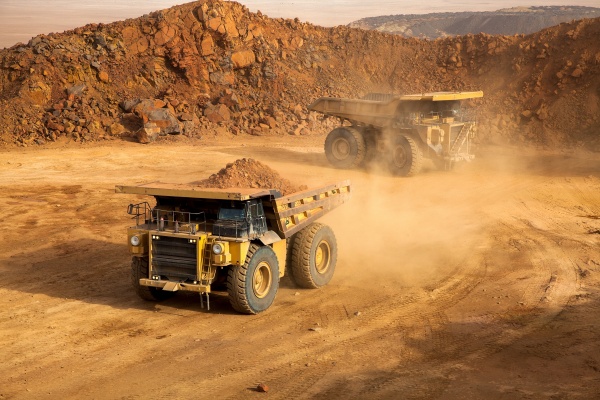
A sodium-ion battery-based electric mining haul truck jointly developed by Chinese equipment maker Tonly Heavy Industries and Hina Battery has been deployed at an operating mine site. Competition is taking shape over next-generation battery technology that could replace lithium-ion batteries not only in passenger EVs but also in the heavy industrial equipment market.
On Aug. 6 local time, EV outlet Electrek reported that Tonly's K120E electric mining haul truck began operating at the Sanyu limestone mine in Tangshan, China.
The key to the vehicle is its sodium-ion battery. The K120E uses Hina Battery's 676 kWh-class Hai Xing series battery. The company introduced it as the world's first sodium-ion battery applied to an electric mining haul truck. The Hai Xing battery is known to be able to charge from 0 percent to 100 percent in minutes and to offer up to 8,000 charge and discharge cycles. Its energy density is 165 Wh per kg.
A key advantage of sodium-ion batteries is seen as a lower burden on raw-material supply chains compared with existing lithium-ion batteries. Unlike lithium, they use abundant sodium resources, which can reduce reliance on mineral supply chains concentrated in specific countries. They also have high thermal stability and can see less performance degradation in low temperatures, which could be competitive for large industrial vehicles.
Northern China, where the vehicle is being deployed, is known for extreme cold in winter. In some areas such as Harbin and Shenyang, nighttime temperatures often fall below minus 20 degrees Celsius. In cold conditions, conventional lithium-ion batteries can see lower output and efficiency, and diesel engines can also face difficulties in starting and maintenance.
There have also been cases in which EVs showed more stable performance than diesel vehicles even in extreme conditions. In 2024, Bethany Orenwen (베서니 오린웬), transportation director for the West Grand County School District in the United States, referred to her experience operating electric school buses and said, "Minus 20 degrees is a good day, but performance was very good." The explanation is that advantages of electric drivetrains are being confirmed in cold regions.
Electrification of mining equipment is important not only for reducing emissions but also for operating efficiency and work safety. That is because if diesel equipment fails to operate properly in extreme cold, it can disrupt production and affect worker safety.
Tonly is also moving to expand autonomous mining equipment along with electrification. The company recently announced it would supply 800 TLE135 autonomous mining trucks to the Hanxiang area of Xinjiang, China. It is a strategy to change how large-scale mines are operated by combining electric drive and autonomous driving technology.
Tonly aims to secure emissions reductions, lower noise, improved work safety and the ability to handle extreme cold at the same time through sodium-ion battery-based mining trucks.
This case is meaningful in that sodium-ion batteries are moving beyond the research stage and beginning to be applied at real industrial sites. Sodium-ion batteries have drawn attention in energy storage systems and low-cost EVs rather than passenger EVs because of their low energy density, but they are expanding their use on the back of high stability and competitiveness in raw materials.
The key going forward is real-world operating data to be secured at mine sites in northern China. If sodium-ion batteries prove stable performance even in extreme cold and under heavy-duty working conditions, they are expected to be more likely to establish themselves as an alternative to lithium-ion batteries in the industrial EV market, including mining equipment.
 Jinju Hong
hongjj@d-today.co.kr
Jinju Hong
hongjj@d-today.co.kr