
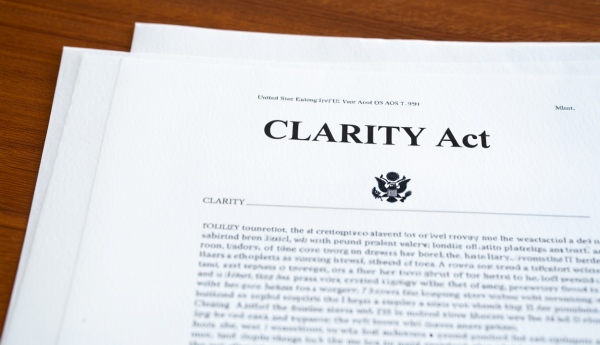
The Trump administration is seeking a bipartisan compromise on ethics rules as it pushes to pass the CLARITY bill, a U.S. digital asset market-structure proposal. How to address conflicts of interest tied to cryptocurrencies, rather than the bill itself, is emerging as the biggest variable for Senate passage.
On Aug. 7 local time, blockchain outlet CoinPost reported that the White House is discussing a compromise reflecting demands from both Democrats and Republicans on ethics rules that have become a central issue in review of the CLARITY bill.
The negotiations began as pro-cryptocurrency forces close to President Trump focused on resolving ethics issues to advance the bill. Eleanor Terrett (엘리너 테렛), Fox News' cryptocurrency reporter, said White House officials have been moving actively this week to reach an agreement on ethics rules.
White House staff are also said to be continuing talks to set up a digital asset regulatory framework while coordinating opposition views from law enforcement agencies and regulators.
Senate procedures remain stalled. Cryptocurrency policy officials are describing the situation as "a state where nothing is visible ahead." As of Aug. 6, the Senate had not filed a motion for cloture to end debate on the CLARITY bill, and the bill is not on the formal agenda.
Time is tight. The Senate is set to handle a continuing budget resolution, a bill to protect college sports, and the confirmation of attorney general nominee Todd Blanche, among other items, on Aug. 7. The CLARITY bill, by contrast, has not even started the voting process, and some analysis says passage before a recess scheduled for Aug. 10 has effectively become difficult.
The Senate will go into recess from Aug. 10, with the session set to resume in mid-September. Even if it does not pass before the recess, the bill is not automatically discarded, but consideration could be prolonged when political schedules ahead of the November midterm elections are taken into account.
The biggest issue is how to reflect in ethics rules the cryptocurrency-related business activities of President Trump and his family. Republican Senator Thom Tillis and Democratic Senator Ruben Gallego are said to have delivered to the White House last week a compromise that would restrict cryptocurrency issuance and sponsorship activities by officials and their spouses, and include a sunset clause applying the rules until January 2029.
Democrats say state attorneys general should be given enforcement authority and that standards for selling related assets should be clarified. They also argue for permanent ethics rules, without a sunset clause, that apply to the president, vice president and all members of Congress.
Republicans, however, say the vote should not be delayed any further. Senate Banking Committee Chairman Tim Scott said in a Fox Business interview on Aug. 6 that the CLARITY bill must be handled before the recess.
Scott argued the CLARITY bill is needed for consumer protection, clear rules for the digital asset market and promotion of innovation. He criticised Democrats for repeatedly changing their demands during discussions and delaying passage.
Whether Republicans can unify internally is also a variable. Scott said support among Republican senators continues to grow, and predicted that if Republicans maintain a single position, Democrats will also have no choice but to participate in the vote.
In markets, attention is focused more on whether the U.S. push to institutionalise cryptocurrencies will hold than on whether the bill passes before the recess. Matt Hougan (맷 호건), chief investment officer at Bitwise, analysed that even if the CLARITY bill does not pass this week, the market impact could be limited.
Hougan said it is likely the bill will not be discarded but that discussions will temporarily stop. He also said the institutionalisation trend will not reverse as the U.S. Securities and Exchange Commission continues separate regulatory work and institutional investor inflows continue.
Ultimately, the bill's outlook depends on whether a compromise on ethics rules can be reached and whether the Senate begins voting procedures. With the pre-recess schedule tight, it is increasingly likely that actual processing will move to the September session.
 Jinju Hong
hongjj@d-today.co.kr
Jinju Hong
hongjj@d-today.co.kr