
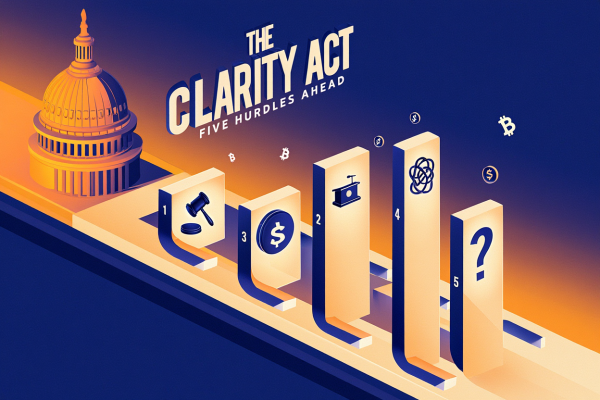
As prospects for the U.S. Senate to pass the Clarity Act dim, an analysis says the benefits of regulatory delays are concentrating on large cryptocurrency companies.
On Aug. 6, foreign media including blockchain outlet Cryptopolitan and IBD reported that large operators such as Coinbase and Circle are moving ahead in fundraising and licensing responses. Small companies, DeFi projects and community banks, meanwhile, are waiting for a new regulatory framework and facing a heavier burden from uncertainty.
The gap also showed up in investment and licensing moves. Cathie Wood (캐시 우드)'s Ark Invest increased its stakes in Coinbase and Circle. Circle secured federal-level approval as a national trust bank in July.
By contrast, Senate Majority Leader John Thune (존 튠) has not presented progress beyond saying he would push for the first vote of the week. That leaves companies able to move with changes in the regulatory environment in an advantageous position.
The Senate had initially been expected to produce a unified draft in mid-July and secure about four weeks to process it before a House vote. But ending a filibuster requires 60 votes, making Democratic cooperation unavoidable for Republicans.
The Senate Banking Committee advanced the bill on May 14 with support from all Republicans and two Democrats. Democrats then demanded that it include an ethics provision limiting senior public officials’ involvement in cryptocurrency businesses. The current unified draft does not reflect that, and discussions are also continuing over how far to grant state attorneys general authority to enforce ethics violations.
The bill has also continued to expand in revisions. Galaxy Research said the draft, which was 278 pages in January, grew to 309 pages in May. More than 70 pages were added as language from the Senate Agriculture Committee was incorporated, and a substantial portion was allocated to consumer protection provisions.
A key point is dividing jurisdiction between the U.S. Securities and Exchange Commission and the Commodity Futures Trading Commission depending on the nature of a token. Centralised exchanges would face clearer operating rules, while DeFi protocols would be subject to operational standards that include definitions for validators and oracles. Token issuers would have disclosure obligations, and intermediaries would be required to register federally and comply with anti-money laundering rules. Those costs are structured in a way that large companies can more easily bear.
The profit function of stablecoins is also an issue. SkyBridge Capital founder Anthony Scaramucci (앤서니 스카라무치) criticised the banking sector for launching a last-minute lobbying push to block the bill. JPMorgan CEO Jamie Dimon (제이미 다이먼) raised concerns that the bill could allow crypto companies to do business and compete without safeguards at the same level as banks.
Senator Cynthia Lummis (신시아 루미스), however, called the bill a "consumer-friendly disclosure framework" for digital assets. She also stressed that more than 16 safeguards to prevent illicit finance have been prepared, pushing back against criticism from Senator Elizabeth Warren (엘리자베스 워런).
Markets are also reflecting the legislative delay. Bitcoin slipped last week from around $65,000 to about $64,300. Bitfire Research cited the Clarity Act delay as well as the U.S. Federal Reserve's hawkish stance, Trump Media's movement of $165 million worth of BTC, and the loss of about 1,367 BTC due to a Coldcard vulnerability as drivers of the decline.
Investor sentiment has also weakened. July inflows into spot bitcoin exchange-traded funds totalled about $205 million, the lowest monthly level since launch.
On prediction market Polymarket, the likelihood the Clarity Act will pass by 2026 fell to 23 percent. Galaxy Research put the odds at 67 to 75 percent in mid-May, and Citibank also pointed to regulatory uncertainty as a key variable in its outlook for bitcoin and ether.
Even if the Senate passes the bill, procedural steps remain. Congress must reconcile it with the House version that passed in July 2025 by 294 to 134 before moving it to the signature stage for U.S. President Donald Trump. If the deadline is missed this week, the next processing window could be September. If that also falls through, it could be pushed into the midterm election period, extending regulatory uncertainty and making that gap more likely to work further in favour of large cryptocurrency companies.
The issue is notable in that it shows who benefits from the regulatory vacuum, rather than whether the bill passes. Large companies with financial strength and licensing capabilities can hold out, but compliance costs and uncertainty are remaining a more direct burden on smaller operators.
 Yoonseo Lee
yslee@d-today.co.kr
Yoonseo Lee
yslee@d-today.co.kr