
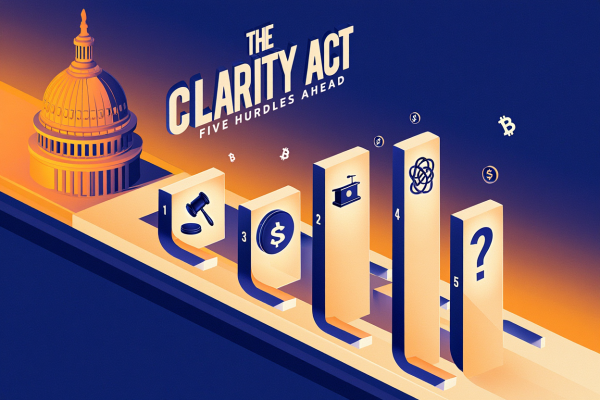
A U.S. Senate cryptocurrency market structure bill known as the Clarity Act has entered a White House review stage, leaving open the possibility of a late vote. Still, with little time left before the Senate goes into recess, whether negotiators can reach a deal has emerged as the biggest variable.
Bitcoin Magazine, a blockchain outlet, reported on Aug. 5 that the latest ethics-language text prepared by a bipartisan negotiating team in the Senate was sent to the White House last week and is now under internal review.
Senator Tom Tillis (톰 틸리스) said working-level consultations with the White House are under way. He said there are staff working with the White House and reviewing parts of the draft. Tillis, who has worked with Democrats to adjust the bill’s ethics-related wording, sees the review as directly tied to whether a vote can go ahead.
The Senate leadership schedule remains uncertain. Senate Majority Leader John Thune (존 튠) did not move ahead with a cloture procedure on the bill on Tuesday afternoon. That leaves the negotiating team needing to narrow differences in a short time before the Senate recess. Thune previously said he still hoped for a vote before the recess, but Republican and Democratic staff have held intensive talks over the past 24 hours to settle remaining issues, the report said.
Expectations for passage are mixed in and around the Senate. Large cryptocurrency companies and major financial institutions raised expectations last week that the bill would pass, but Congress has shown a pattern of prioritising other bills ahead of a five-week recess. The schedule pressure has raised the possibility that the Clarity Act could be pushed down the list despite its policy importance.
Some Republicans also complained that Democrats are deliberately slowing the bill. Senator Cynthia Lummis (신시아 루미스) and others argued that Democrats are intentionally delaying it. Tillis, by contrast, linked the chances of a vote to the Senate’s actual stay in Washington. He said it would be difficult to hold a vote at this point if the Senate leaves Washington as scheduled on the afternoon of Aug. 6. He added that a possibility still remains if the schedule slips and extends into next week.
Outside the Senate, pressure to move the bill has also grown. Senator Lindsey Graham (달린 그레이엄), a Republican from South Carolina, urged swift passage on X, formerly Twitter. He stressed that the Clarity Act is central to U.S. President Donald Trump’s stance of keeping digital-asset innovation in the United States. He also said the Senate should produce legislation that protects consumers, gives authority to law enforcement agencies and provides regulatory clarity to the industry.
A key procedural issue is when a cloture motion is filed. If the Senate files it on Aug. 6, a floor vote could take place as early as this weekend. If action slips into next week, it is likely to be effectively the last window to try to pass the bill before the recess. The White House review of the ethics language and the Senate leadership’s scheduling decision are expected to determine the Clarity Act’s near-term direction.
 Yoonseo Lee
yslee@d-today.co.kr
Yoonseo Lee
yslee@d-today.co.kr