
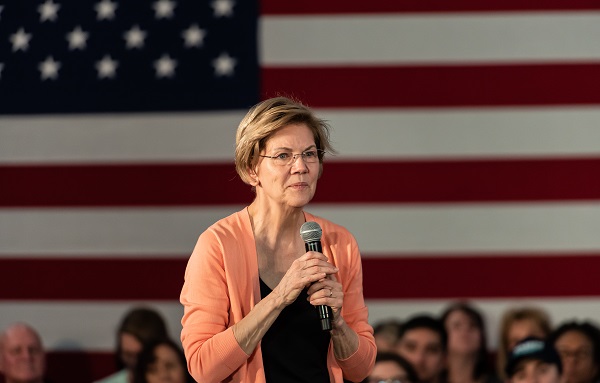
U.S. Senator Elizabeth Warren has demanded an explanation from the Commerce Department, questioning a link between the U.S. government's move to ease export restrictions on artificial intelligence (AI) semiconductors for the United Arab Emirates (UAE) and a cryptocurrency business tied to the Trump family.
Cointelegraph, a blockchain media outlet, reported on Aug. 5 that Warren urged Commerce Secretary Howard Lutnick in a letter to explain whether the president's cryptocurrency interests influenced the process of expanding access to advanced AI chips for the UAE.
At the centre of the controversy is an investment relationship between the UAE and World Liberty Financial, a cryptocurrency business linked to President Donald Trump. Warren said the U.S. government expanded the UAE's access to advanced semiconductors after UAE-related entities became connected to World Liberty Financial, and asked whether the policy process may have involved a conflict of interest.
An Abu Dhabi-based institution backed by Sheikh Tahnoon bin Zayed Al Nahyan was reported to have invested $500 million in World Liberty Financial in January. Another UAE-linked company completed a $2 billion investment in crypto exchange Binance using World Liberty's USD1 stablecoin.
Warren raised questions about whether those investment flows coincided with shifts in U.S. government policy. In the letter, she said the Commerce Department's steps "raise serious questions about how the president's cryptocurrency business interests are influencing agency operations and national security decisions".
The Commerce Department later changed the UAE's export-control classification to "Country Group A:5". The change gave the UAE broader access than before to certain advanced technology products, including AI chips. The department was also reported to have said it would "look favourably" at export licence applications for chips and servers linked to UAE entity MGX, which was involved in the Binance investment.
Democratic lawmakers see the matter as a chance to examine links between foreign funding flowing into the U.S. cryptocurrency industry and the policy decision-making process. In June, some senators including Warren called for hearings over the UAE side's $500 million investment in World Liberty Financial and said the impact of foreign capital on Trump-linked crypto businesses should be investigated.
Congress is also looking into the issue of President Trump's possible pardon for former Binance chief executive Changpeng Zhao (창펑 자오). A key issue is whether foreign money flowing into U.S. crypto businesses affected regulatory policy or export-control decisions.
The specific criteria and national security rationale behind the Commerce Department's decision to ease restrictions on the UAE have not been clearly disclosed.
Lawmakers' focus is expected to turn to what procedures and assessments led to expanded AI chip exports to the UAE, and in particular what standards underpinned the "favourable review" mentioned in licensing reviews related to MGX.
 Jinju Hong
hongjj@d-today.co.kr
Jinju Hong
hongjj@d-today.co.kr