
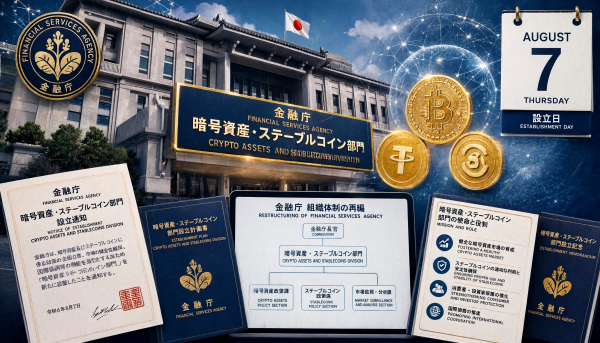
Japan's Financial Services Agency is setting up an independent organisation dedicated to cryptocurrencies and stablecoins as it moves to strengthen its digital asset supervision framework. It is upgrading the relevant organisation, previously at the level of a counsellor's office, to a division, and cryptocurrency policy and supervisory functions within Japan's financial authorities are expected to expand further.
CoinPost, a blockchain outlet, reported on Tuesday that the agency will establish a “Cryptocurrency and Stablecoin Division” through an organisational reshuffle on Aug. 7. The change expands and reorganises the existing “Cryptocurrency, Blockchain and Innovation Counsellor's Office” under the Strategy Development and Management Bureau into an independent division.
The new division will be placed under the Asset Management and Insurance Bureau. The agency cited the implementation of a policy to make Japan an asset management hub, responding to digitalisation in the financial sector, and upgrading market monitoring functions as reasons for the reorganisation.
The biggest change is the unit's status. The previous counsellor's office was largely geared toward dealing with specific areas, but its upgrade to a division will allow it to carry out cryptocurrency-related regulatory planning and supervision in a more systematic way.
The existing crypto monitoring office will remain under the new division. At the same time, the existing innovation promotion office will be split into an “Innovation Promotion Office” and a “Digital Payments Planning Office.” This means one organisation will handle not only surveillance of the crypto market but also institutional design and policy functions in payments.
The change in the unit’s name is also drawing attention. “Stablecoin” has been newly added, replacing “blockchain and innovation” that had been included in the previous name. This has been analysed as showing that the agency sees the need to supervise financial services areas such as stablecoin issuance and distribution as more important than blockchain technology itself.
In Japan, discussions on payments and financial services using stablecoins have recently expanded. As a result, financial authorities are shifting their focus away from oversight centred on crypto exchanges and toward managing digital assets broadly within the regulated financial sector.
The organisation for payments will also be reorganised. The agency will upgrade the existing “Funds Settlement Counsellor's Office” into a “Funds Settlement Division,” and transfer the financial services brokerage office, the office for electronic payment agencies, and the payments and digital finance group monitoring office, among others, into that division. Those organisations had previously been under the risk analysis coordination division of the Strategy Development and Management Bureau. After the reshuffle, they will handle payments separately from the cryptocurrency and stablecoin division.
Following the reshuffle, the agency’s supervisory structure will be reorganised around the Banking and Securities Bureau and the Asset Management and Insurance Bureau. The cryptocurrency and stablecoin division will be incorporated into the Asset Management and Insurance Bureau, reflecting an assessment that the direction of Japan's government is to clearly treat digital assets as one subject of financial supervision.
The agency plans to apply transitional measures for a certain period that recognise the previous framework for documents and application forms prepared before the organisational reshuffle. After Aug. 7, market participants will need to confirm the new supervisory contact point and responsible division.
The move shows a trend in Japan toward incorporating cryptocurrencies as part of the financial system rather than simply an area of technological innovation. In particular, the establishment of a dedicated stablecoin unit is expected to draw attention to the future direction of regulation, as it marks Japan's financial authorities moving in earnest to manage the digital asset market and refine the institutional framework.
 Jinju Hong (홍진주)
hongjj@d-today.co.kr
Jinju Hong (홍진주)
hongjj@d-today.co.kr