
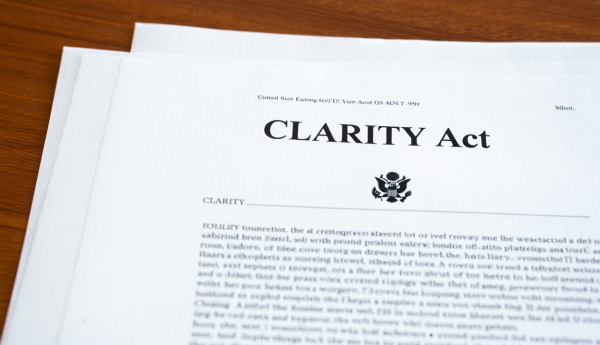
A demand has emerged in the U.S. Senate to include a state-jurisdiction provision related to sports gambling in the Clarity bill, a crypto market structure measure.
CoinPost, a blockchain media outlet, reported on Aug. 5 that the Senate Committee on Indian Affairs held a roundtable meeting on Aug. 4 to discuss regulation of prediction markets. Senators and tribal gaming regulators who attended said jurisdiction over sports gambling should remain with state governments.
The issue is who should oversee sports-related contracts offered by prediction market platforms. One side argues the U.S. Commodity Futures Trading Commission (CFTC) should have sole regulatory authority. The other argues existing state and tribal gaming laws should take priority. At the meeting, opposition was raised publicly to concentrating authority in the CFTC.
Tehassi Hill (테하시 힐), vice chairman of the National Indian Gaming Association, asked senators to amend the Clarity bill to add a provision banning sports and casino gambling through prediction markets. He argued the bill should clearly state that state and tribal gaming laws take priority over the CFTC.
Democratic Senator Tina Smith (티나 스미스) said language to the same effect could be included in the Clarity bill or the farm bill. Smith said, "There are already tools to make clear that the CFTC's authority does not exclude the Indian Gaming Regulatory Act or compacts between tribes and state governments." She also said prediction markets should follow the existing legal framework.
The dispute has grown rapidly over the past year. The Donald Trump administration has supported granting prediction market oversight authority to CFTC Chair Michael Selig and has described it as "very important." Selig, by contrast, has argued the CFTC has "exclusive jurisdiction" over prediction markets and has filed lawsuits against several states. States are pushing back, saying sports-related contracts in particular could violate their gambling laws.
Market interests are also clear. Prediction market platforms Polymarket and Kalshi have seen a surge in users, and their corporate valuations have grown to several billion dollars. Both companies support a single regulatory regime centered on the CFTC. As prediction markets are being included in bill discussions directly linked to crypto, the Clarity bill has gained additional political variables for the digital asset industry.
The legislative timeline also remains uncertain. A consolidated draft by the Senate Banking Committee and the Agriculture Committee was released around July 22, and the bill is on the Senate calendar. But no cloture motion has been filed in the Senate so far.
Senate Majority Leader John Thune (존 튠) told reporters on Aug. 4 that he expects the Senate to hold the first procedural vote before the recess running from Aug. 10 to Sept. 14. He said it was unclear whether the cloture vote would actually pass. The White House has yet to provide an answer on the ethics provision, seen as the biggest issue.
Under Senate rules, once a cloture motion is filed, a vote is typically held on the second day after an intervening one business day, and passage requires 60 votes. If it passes, the Senate moves to a vote to begin formal consideration after up to 30 additional hours of debate. Another cloture motion is then needed on the bill itself, meaning two separate 60-vote thresholds must be cleared before a final vote.
As a result, the Clarity bill is taking on a new issue on top of the ethics provision: jurisdiction over sports gambling. Even if the Senate proceeds with the first procedural vote before the recess, whether to amend the bill and securing a bipartisan 60 votes remain tasks still ahead.
 Jinju Hong
hongjj@d-today.co.kr
Jinju Hong
hongjj@d-today.co.kr