
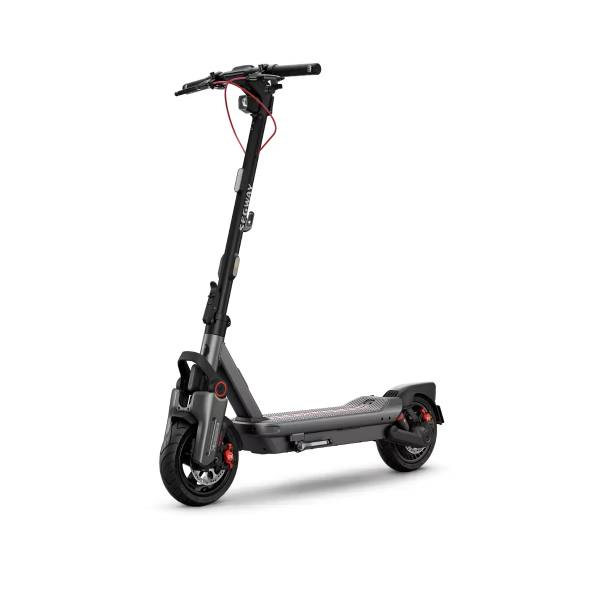
Segway has unveiled a new flagship commuter electric scooter, strengthening battery performance and safety specifications at the same time. It also drew attention by changing how it calculates range to narrow the gap between the maker’s maximum figure and the distance riders feel in real use.
On Aug. 4, electric vehicle outlet Electrek reported that Segway unveiled the MAX G3 Plus, a new model in its premium commuter MAX series.
The new model has a 717Wh battery, 20 percent larger than the previous model. Segway said it offers a maximum range of 56 miles, about 90 km, in low-power mode. Top speed is 28 miles per hour, about 45 km per hour, and maximum motor output is 2,200W.
The biggest change in this model is not battery capacity but how range is displayed. Segway applied a new standard closer to real riding conditions instead of measuring distance until the battery is fully depleted, as it did previously.
Under the new standard, range is calculated based on the point at which the rider can no longer maintain at least 60 percent of top speed in the selected riding mode. The method reflects performance degradation even if the battery still has charge. Segway described it as “a change to provide riders with information closer to the actually usable distance.” Officially, the range is about 6 miles longer than the previous MAX G3, but Segway said the improvement would be about 12 miles if the prior model were re-measured using the same standard.
Safety has also been strengthened. The MAX G3 Plus adds rear turn signals in addition to the existing handlebar indicators, and improves the brake lever design and the position of reflectors. It also applies an intelligent integrated braking system, or ICBS, that combines a regenerative braking system with mechanical disc brakes. Segway said the system increases braking force while recovering battery energy and reducing brake wear.
Ride comfort and convenience features were also significantly expanded. The new model applies dual hydraulic suspension, adjustable rear damping and 11-inch self-sealing tires. It also supports traction control, an anti-lock braking system and integration with Apple’s Find My.
Driver convenience features include a 2.4-inch TFT display that supports navigation, automatic headlights, high-beam and low-beam functions, and fast-charging technology. Charging time is about 4 hours as standard, and can be reduced to about 3 hours using a dual charging cable.
The product weighs 55.6 pounds, about 25.2 kg, and has a maximum load of 286 pounds, about 130 kg. It is assessed as typical for premium commuter products that apply large-capacity batteries and high-performance components.
Sales will start in the U.S. market. The MAX G3 Plus is currently available for pre-orders, with an initial price of $1,149.99. The regular suggested retail price is set at $1,499.99. The U.S. launch is scheduled for Aug. 25, and it will be sold through Segway’s official online store and major retail channels such as Best Buy and Amazon.
The industry assesses the model’s core competitiveness as not simply a larger battery but a focus on real-world range. In the electric scooter market, it has been common to display maximum range based on the lowest power setting and ideal conditions, prompting criticism that it differs from what users feel in practice.
Still, because the MAX G3 Plus maximum range is also calculated based on low-power mode, differences may occur in actual commuting environments depending on road conditions, speed and body weight. Attention is focused on whether Segway can change how the market competes on range through the new measurement standard.
 Jinju Hong (홍진주)
hongjj@d-today.co.kr
Jinju Hong (홍진주)
hongjj@d-today.co.kr