
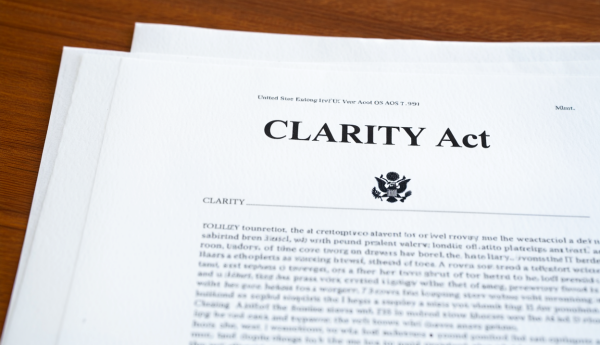
A bill seen as central to overhauling the structure of the U.S. cryptocurrency market has entered last-minute negotiations ahead of Congress' recess, but the chance of it passing this year remains low. The Senate is pushing to move the bill before the recess, but vote counting and coordination on key disputes remain variables.
According to blockchain outlet CryptoSlate on Aug. 3 local time, the U.S. Senate is trying to take up the CLARITY Act by Aug. 7, its final scheduled day before the August recess. But the floor schedule released that day was reported not to include the bill yet.
The biggest hurdle is securing enough votes to meet the threshold. Republicans hold 53 Senate seats, but ending debate to block a filibuster requires 60 votes. Even if all Republicans back the bill, it would still need the support of at least 7 Democrats or Democratic-leaning independents. The final vote count is further complicated because Republican senators Josh Hawley and Rand Paul oppose it.
The House passed the CLARITY Act in July 2025 as H.R. 3633 by a 294-134 vote. The Senate Banking Committee then advanced its own revised version in May 2026 by a 15-9 vote, and Senator Cynthia Lummis released a negotiating draft in July that combined language from the Banking and Agriculture committees. Senate discussions are now focused on that draft.
But Democratic pushback has grown since the draft was released. The key dispute is ethics rules. Democratic lawmakers argue that the current draft does not sufficiently restrict existing cryptocurrency business profits by senior officials, including President Donald Trump.
The current draft restricts some senior officials from issuing or sponsoring digital assets until 2029. But it does not clearly address how existing holdings would be handled, who would enforce the rules, or the structure of family businesses, keeping the issue contentious in negotiations.
Stablecoin rewards have also emerged as a major issue. Banks are calling for additional limits, arguing that rewards on stablecoins could replace deposits in traditional finance and strain the banking system. The crypto industry, in contrast, argues that excessive restrictions could block competition and work in favor of the existing financial sector.
The current negotiating proposal is reported to have been adjusted to ban rewards similar to passive interest payments on stablecoin balances, while allowing rewards generated through trading, staking and platform activity. Still, some say it is insufficient to address banks' concerns.
Anti-money laundering (AML) and consumer protection rules are also remaining issues. The draft includes digital asset exchanges, brokers and dealers under the Bank Secrecy Act, imposing know-your-customer (KYC), suspicious transaction reporting and sanctions compliance obligations. Democrats, however, argue that regulatory gaps remain in some areas, including decentralized platforms and mixers.
Procedural issues are also a variable. Analysis suggests it will not be easy to complete all steps within the remaining 5 trading days because time is needed for motions to proceed, cloture filings and handling amendments. The CLARITY Act has recently been competing for floor time with personnel matters, sanctions bills and government budget items, and if it falls down the priority list, action could slip to after September.
Market expectations are also cautious. Galaxy on July 25 put the chance of the CLARITY Act passing in 2026 at about 30 percent, citing the schedule and political vote counting as key constraints. Prediction market Polymarket also shows odds in a similar range.
A final variable closely watched by the industry is whether the ethics provisions are revised and whether Senate leadership is willing to move the bill. If procedural steps such as a motion to proceed and cloture begin before the recess and a list of supporting lawmakers is made public, the chances of passage could rise. If there is no clear progress, discussions on the CLARITY Act are likely to carry the same core disputes into after September.
 Jinju Hong
hongjj@d-today.co.kr
Jinju Hong
hongjj@d-today.co.kr