
[Digital Today reporter Sangyeop Oh (오상엽)] A subsidiary created through a physical split must obtain approval from shareholders of the parent company to pursue a duplicate listing on the domestic stock market. A regular subsidiary must also undergo the Korea Exchange's tighter case-by-case review if it fails to secure shareholder approval.
The Financial Services Commission said on Thursday it approved amendments to the Korea Exchange's listing and disclosure rules aimed at improving the duplicate listing system at a regular meeting. The revised rules and the duplicate listing guidelines will take effect on Aug. 3.
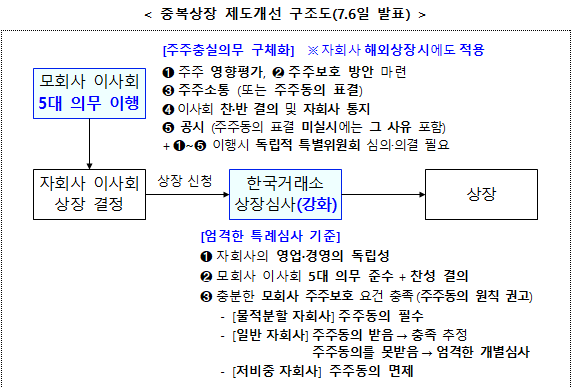
The key to the new system is that duplicate listing reviews will reflect a subsidiary's operational and management independence, whether the parent company's board has fulfilled its duty to protect shareholders, and measures to protect the parent company's ordinary shareholders.
A subsidiary set up through a physical split must obtain parent shareholder approval as a requirement during the duplicate listing process. A regular subsidiary will be presumed to have met shareholder-protection requirements if it secures shareholder approval, but will face the exchange's strict case-by-case review if it does not.
Low-weight subsidiaries with a small impact on the parent company are excluded from the shareholder-approval requirement. Listings of securities that qualify as collective investment securities under exchange rules, such as real estate investment trusts (REITs), are also excluded.
The so-called 3 percent rule will apply, as in the previously announced plan, when determining whether shareholder approval has been obtained. Shareholders holding more than 3 percent will have their voting rights capped at 3 percent, and approval will be recognised only if a majority of participating shares and at least one quarter of total shares outstanding vote in favour.
The business community called for easing the requirement to a standard ordinary resolution, while the investment industry argued for applying a majority of minority (MoM) rule. The commission and the exchange decided to keep the existing method. The aim is to reduce the possibility of securing approval based solely on the will of controlling shareholders while also dispersing the influence of large shareholders.
The parent company's board must assess how the subsidiary's listing affects shareholders and prepare shareholder-protection measures. After communicating with shareholders or conducting the approval process, it must vote on whether to support or oppose the listing and then notify and disclose the result to the subsidiary.
Independence standards were also tightened for a special committee that deliberates whether the board has fulfilled its duties. An independent director must chair the committee, and independent directors and outside members must make up at least two thirds of the committee.
Electronic voting will not be mandated in the shareholder-approval process, but will be recommended. The final board resolution will be disclosed only as the overall result of the board vote, rather than how each director voted.
The commission and the exchange plan to periodically supplement the guidelines after implementation based on actual cases of board duty fulfilment and listing reviews.
 Sangyeop Oh
yub@d-today.co.kr
Sangyeop Oh
yub@d-today.co.kr