
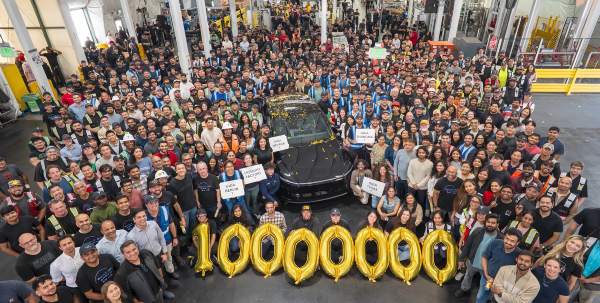
Tesla has produced its 10 millionth electric vehicle (EV) at its Fremont plant in California.
On July 30, multiple foreign media reported that Tesla announced the news in a post on X, formerly Twitter. Tesla has become the first automaker dedicated to producing only EVs to reach an eight-digit cumulative production total.
Tesla took 12 years to build its first 1 million vehicles, but it took only 6 years to reach 10 million after producing its 1 millionth vehicle in 2020. Some see it as a milestone showing that mass-producing EVs can also secure profitability.
China's BYD is cited as a comparison. BYD reached 10 million new energy vehicle (NEV) sales in 2024, but the figure includes both battery electric vehicles and plug-in hybrids (PHEVs). Tesla's record differs because it is based only on pure EV production.
The achievement is also tied to Tesla CEO Elon Musk’s compensation structure. Ten million is half of the 20 million operating target reflected in Musk’s roughly $1 trillion pay package approved by shareholders last year. He must surpass 20 million vehicles for Tesla to secure that pay tranche. The announcement confirms the remaining gap in specific numbers.
Even so, the business environment remains challenging regardless of the production milestone. Tesla set an all-time high by delivering 1.81 million vehicles in 2023, then saw sales fall for a second consecutive year. In 2024, it posted its first-ever annual decline to about 1.79 million. In 2025, it fell 9 percent from a year earlier to 1,636,129. The market points to an aging lineup, intensifying competition and consumer backlash tied to Musk’s political activities as factors behind the slowdown.
Tesla has presented investors with a goal of about 50 percent average annual growth, and Musk has repeatedly mentioned it at each earnings release. But that growth stopped after peaking in 2023. In a first-quarter 2024 shareholder letter, Tesla said it was "currently between two growth waves." It said the first wave was Model 3 and Model Y, and previewed the second wave as a cheaper next-generation vehicle. More than 2 years later, the second wave has yet to materialise.
A gap has also emerged between production capacity and actual utilisation. Tesla’s own disclosures put annual capacity by plant at more than 950,000 in Shanghai, more than 550,000 in Fremont, more than 375,000 in Berlin, and more than 2,375,000 in total after adding 250,000 in Texas for Model Y, 125,000 for Cybertruck and 125,000 for Cybercab. But Tesla’s actual output in the second quarter of 2026 was 451,758 vehicles, and deliveries were 480,126. Annualised, that quarterly pace implies production of about 1.8 million this year, more than 500,000 below its stated capacity. That shows Tesla is facing a lack of demand rather than supply constraints.
Its lineup is also failing to support growth. The best-selling Model 3 and Model Y are older models sold since 2017 and 2020, respectively. Cybertruck, which was expected to sell in large volumes, has struggled, and while it has a loyal customer base, its role as an additional growth engine has been limited. Cybercab and the semi truck remain in the early stages of mass production, and the Roadster has remained in the design and development stage for years.
Its robotaxi business is also moving slowly. Some Model Y robotaxis are operating in parts of the Bay Area, Texas and Florida, but most vehicles have a human supervisor riding along. The number of robotaxis is shrinking, and development of the humanoid robot Optimus continues to be delayed.
Still, some signs of stability have emerged in its passenger-car business. Tesla rebounded with 25 percent growth year on year in the second quarter this year, which is seen as driven by high gasoline prices in Europe that stimulated EV demand. Tesla launched the long-wheelbase Model Y L in the United States this month, and it is also reported to be preparing a smaller Bolt-sized EV, but the company has not officially confirmed it.
The 10 million milestone is seen as a genuine marker of achievement, but some also view it as evidence that Tesla’s EV business has stagnated. Assessments say the growth story that drove its stock price for nearly a decade ended in 2023. They also say the current situation is not a temporary gap between two growth waves, but a result of halting investment in next-generation EVs and shifting the future to robots and robotaxis.
Ultimately, Tesla’s car business matters because it serves as a funding source for large-scale investment in artificial intelligence (AI), robotics and autonomous driving. Producing 10 million vehicles is a clear milestone, but some point out that much higher vehicle sales are needed to sustain this investment structure.
10 million vehicles produced globally. Congrats to all Tesla teams! pic.twitter.com/JkcraR63bs
 Seung-a Yoo
ysah@d-today.co.kr
Seung-a Yoo
ysah@d-today.co.kr