
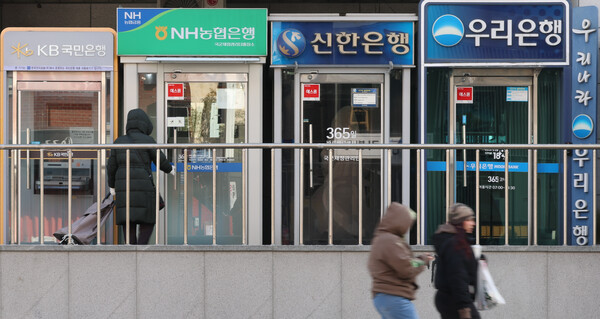
Bank ETF trust trading has surged, but most of it is short-term. A large share of investors chose upfront fees and incurred unnecessary costs, a review showed. The Financial Supervisory Service issued a consumer alert to bank ETF trust investors and said it would improve the fee structure, banks' performance evaluations and sales procedures overall.
The FSS on Wednesday issued a "caution" consumer alert, saying short-term trading and fee burdens in bank ETF trusts are growing.
According to the FSS, six banks - KB Kookmin, Shinhan, Hana, Woori, Standard Chartered First Bank Korea and NH Nonghyup Bank - sold 64 trillion won of ETF trusts in 1.03 million contracts from January 2025 to May 2026.
Monthly sales rose 8.8 times to 10.8 trillion won in May this year from 1.2 trillion won in December 2025. Over the same period, monthly trust fee revenue climbed 10.2 times to 103.6 billion won from 10.2 billion won. Across the full survey period, banks earned 586.4 billion won in ETF trust fee revenue.
AVERAGE HOLDING 42 DAYS...94.6 PERCENT SOLD WITHIN SIX MONTHS
ETF trust investors held positions for an average of 42 days, and the same investor signed an average of 5.5 contracts, the FSS said. Of all transactions, 62.7 percent were sold within one month, 85.9 percent within three months and 94.6 percent within six months. Ultra-short trades cancelled within 10 days accounted for 37.9 percent.
Although most trading was short-term, 91.7 percent of contracts cancelled within six months chose upfront fees. Upfront fees are paid in a lump sum at sign-up, at around 1 percent of the investment amount. Deferred fees are charged at about 1 percent a year and are paid in proportion to the actual holding period, making the deferred method more favourable the shorter the investment period.
The FSS recalculated fees by applying deferred fees for cancellations within one year and upfront fees for cancellations after one year. It found appropriate fees would have totalled 54.5 billion won. However, actual fees received by banks totalled 394.8 billion won, 7.2 times the appropriate level.
Over the same period, ETF trust customers recorded disposal gains of 2.91 trillion won. Trust fees received by banks were equivalent to 13.6 percent of those gains.
The FSS said many accounts set low target returns, which it assessed as increasing fee burdens. Accounts with target returns set at 5 percent or less accounted for 58.1 percent, and those at 3 percent or less made up 20.8 percent. The lower the target return, the more often automatic selling occurs, and upfront fees can be repeatedly incurred in the process of re-subscribing to products.
In one case, an investor in their 70s who invested 100 million won traded ETFs 13 times over about five months and paid 17.04 million won in upfront fees. Under the same conditions, choosing deferred fees would have cut fees to 560,000 won, and the final investment amount would have been 24.21 million won higher than under the upfront method, the FSS calculated.
The average age of investors was 59, and those aged 65 and older accounted for 29.9 percent. Most subscriptions, 93.3 percent, were made through in-person channels such as bank branches.
OVERHAULING THE FEE SYSTEM
The FSS said investors planning to trade ETFs over a short period would benefit from choosing deferred fees.
It also said setting target returns excessively low, such as 1 to 3 percent, can lead to frequent trading and higher fee burdens.
Bank ETF trusts have higher transaction costs, including trust fees, than direct trading through securities firms' mobile trading systems, it said, making them unsuitable for short-term repeated trading.
Even for products subscribed to at banks, equity ETFs can result in principal losses depending on stock price movements. Banks trade ETFs in splits or with delays after receiving customers' trading instructions, which can also create a gap between the price at the time of instruction and the actual execution price.
The FSS will form a task force with banks and related associations to review trust fee structures from scratch, including ETFs. It will examine the structure and appropriateness of upfront and deferred fees, early cancellation fees and trading commissions, and discuss measures to reduce consumer burdens.
It will also check whether banks' key performance indicators for trust business appropriately reflect customer investment returns and the interests of financial consumers. It plans to have banks move away from short-term trading-focused sales dependent on the individual capabilities of branch staff, and to establish company-wide sales strategies that consider customers' asset levels and age, investment objectives and investment horizons.
 Ji-young Lee (이지영)
ljy@d-today.co.kr
Ji-young Lee (이지영)
ljy@d-today.co.kr