
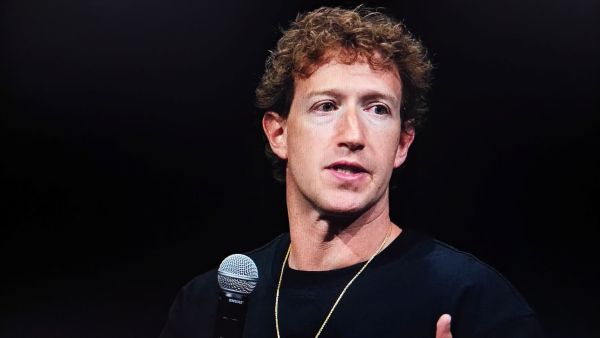
Meta CEO Mark Zuckerberg (마크 저커버그) said superintelligence should be spread in a form that anyone can use, rather than being concentrated in a small number of institutions.
Japanese ITmedia reported on Tuesday that Zuckerberg argued in a Wall Street Journal op-ed, "The AI Future Is for Everyone," that the core of the superintelligence era is not whether the technology is realised but who will be able to use it.
Zuckerberg said AI that surpasses human capabilities will be used in the next few years for new discoveries, creation and starting businesses. He set out three pillars for Meta’s direction: empowering individuals, invention rather than automation, and a balance of power. He said it is more important to build a structure that individuals can use than an approach that controls superintelligence around companies or specific institutions.
He also took direct aim at pessimism spreading among AI developers. He said the idea that because AI is dangerous, extreme concentration of power is the only safe path is itself dangerous. He added that expecting absolute power to benefit humanity in good faith has historically not produced good results.
Zuckerberg cited imbalance when access to superintelligence is granted only to a few. He said unfairness would arise if only one person could use a superintelligent lawyer, but if everyone can use it, the judicial system could become fairer and more efficient. It showed that Meta views superintelligence as both a service strategy and a form of social infrastructure.
On risk management, he proposed a field-by-field approach. In cybersecurity, he said, as the history of open-source software shows, expanding access to powerful systems could lead to long-term safety. In sensitive areas such as biological risks, he drew a line, saying cooperation with governments and related institutions is effective.
On employment, he said the spread of technology does not lead only to job reductions. Zuckerberg said if superintelligence is widely distributed, it will be possible to start businesses with less capital, and jobs could instead increase. He sees AI as going beyond a tool that replaces existing work to one that can spur the formation of new businesses and expand productivity.
Industry reactions followed quickly. Microsoft CEO Satya Nadella (사티아 나델라) wrote on X that Zuckerberg’s piece was a "good argument." He added that building a frontline ecosystem that empowers every person and organisation is a task to pursue together. Alexandr Wang (알렉산더 왕), who leads superintelligence research at Meta, also agreed with Zuckerberg’s argument.
The comments also intersect with a growing debate in the industry over open-weight models. Meta and Microsoft signed a joint letter last week with Nvidia and others asking the U.S. government for policy support for open-weight models. The debate continued as OpenAI and Anthropic did not initially join the letter.
In connection with this, Anthropic CEO Dario Amodei (다리오 아모데이) also released a document on Sunday saying he had never argued for banning open-weight models.
Debate over the scope of access to superintelligence, safety guardrails and the level of openness appears to be spreading across big tech and AI companies. Meta, through the op-ed, shifted the focus of the superintelligence race from performance itself to questions of access and the distribution of power.
 Jinju Hong
hongjj@d-today.co.kr
Jinju Hong
hongjj@d-today.co.kr