
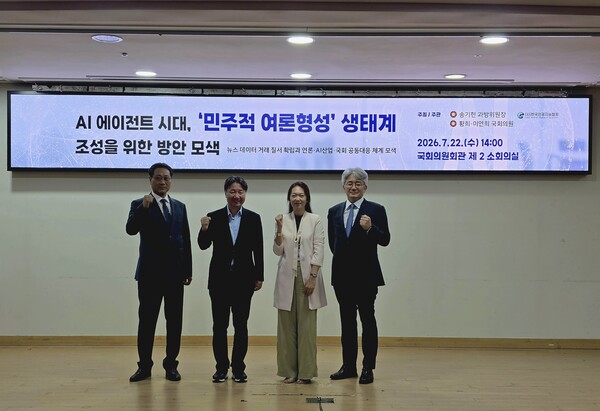
The Korea Artificial Intelligence Association and offices of Song Ki-heon, chair of the National Assembly’s Science, ICT, Broadcasting and Communications Committee, and lawmakers Hwang Hee and Lee Yeon-hee held a meeting on July 22 to review the impact of the spread of AI agents on news distribution and the formation of public opinion, and to seek a sustainable media-AI cooperation model.
Held under the theme, "Seeking measures to build an ecosystem for democratic public opinion formation in the era of AI agents," the meeting was arranged to discuss systems for news data access, control and compensation, as well as a joint response and cooperation framework among the media, the AI industry and the National Assembly.
In the first presentation, Woo Tak-lee (이우탁), an adjunct professor at Sogang University, said the media faced a double crisis of being captured by AI as well as by portals. Under the theme, "Solidarity to rebuild good journalism in the AI era, and PSM," he proposed that public service media (PSM) led by public broadcasters should redesign the news distribution order based on three pillars: public data, public algorithms and public platforms.
In a presentation titled, "Changes in the news distribution structure in the AI era and a joint response," Kim Kyung-tae (김경태), vice chairman of the Korea Artificial Intelligence Association and head of the AI Media Content Institute, introduced the standardisation strategy of Europe’s SPUR alliance, dubbed NATO for news, involving 37 media companies and organisations from 13 countries including the BBC and AP. He also proposed three technology standards covering content access, licensing and usage tracking, the establishment of an association of news providers to implement them, and legislative support including mandating transparency of how AI companies use content.
In a presentation titled, "Media data distribution and transaction models from the perspective of the AI and data industries," Jeong Seung-kyeong (정승경), head of the Korea Artificial Intelligence Association’s Data Trust Center, presented a transaction structure benchmarked on Germany’s automotive industry Catena-X and the European media data space.
Jeong moderated a panel discussion joined by Kwon Oh-hyun (권오현), a director at Nexin Technology, and Ha Seong-heun (하성흔), a senior executive director at Korea Trade Network. They discussed principles for access, control and compensation for news data, securing provenance and transparency for AI services, fair transaction standards between media companies and AI firms, and joint management models such as data trusts.
Song said, "Now that AI agents have deeply entered the public’s information search and decision-making, the order for using news data is an issue of designing democracy’s information foundation." He added, "The National Assembly will also play its role in building an institutional foundation for transparent rules of use, fair compensation, and mutually beneficial cooperation."
Kim Hyun-cheol (김현철), chairman of the Korea Artificial Intelligence Association, said, "AI innovation and the sustainability of journalism are not a matter of choosing one over the other." He added that to create trustworthy AI and a healthy media ecosystem together, rights and transaction standards for news data must be made transparent and the AI industry must be linked to use high-quality data through proper procedures.
 Chi-gyu Hwang
delight@d-today.co.kr
Chi-gyu Hwang
delight@d-today.co.kr