
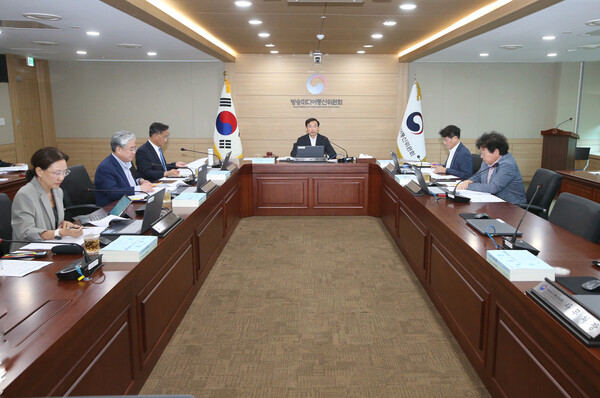
The Broadcasting Media and Telecommunications Committee has decided to fully review the broadcast evaluation system reflected in the re-licensing and re-approval of broadcasters. It aims to redesign regulatory direction and evaluation criteria in line with a rapidly changing media environment, rather than merely partially supplementing the evaluation framework prepared during the former Korea Communications Commission era.
At its 24th plenary meeting held on July 22, the committee received a report on a partial revision draft of the Rules on Broadcast Evaluation and decided to put it back on the agenda after further discussion.
The draft prepared by the secretariat included strengthening evaluation of a self-regulatory system related to fairness, assessing fact-check operations and creating a new item to evaluate efforts to improve working conditions for non-regular workers. It had also planned to improve how it assesses local programming that implements regionality at regional terrestrial broadcasters, as well as the method for evaluating disaster broadcasting and public service advertising schedules.
However, commissioners ordered that the overall broadcast evaluation system should be reviewed again, going beyond the level of revising some individual evaluation items.
Commissioner Sang-geun Lee (이상근) said, "These are evaluation criteria from the KCC era, and now it is Bamito." He added, "Unless we act boldly, the broadcasting industry could be damaged, so the evaluation criteria should be reorganised from scratch."
Lee stressed that with the boundaries of the broadcast market breaking down and mergers and acquisitions and content collaboration among operators becoming important, evaluations should reflect not only fairness but also industrial competitiveness and management performance.
He said, "Like Naver's News Partnership Evaluation Committee, private self-regulatory bodies that have a big impact on the market should also be watched with interest by Bamito in its role as a check."
Commissioner Seong-ok Yoon (윤성옥) said, "Broadcast evaluation is ultimately regulation." She added, "There is a need to reduce evaluation items, ease operators' burdens and focus on areas that must be evaluated."
Commissioner Soo-young Choi (최수영) said she agreed with the revision direction related to fairness and fact-checking, but added, "For a new committee to fully capture the changed media environment, in-depth deliberation among commissioners is needed."
Chairman Jong-cheol Kim (김종철) said, "If broadcast evaluations are to be carried out in line with the changed environment from next year, we must thoroughly consider the rules first." He added, "We will review the broadcast evaluation rules, detailed criteria and the basic 2027 broadcast evaluation plan in a linked manner."
The committee said it would take in more views from commissioners and then receive another report on the revision draft. The new evaluation criteria are expected to apply from 2027 broadcast performance.
 Seulgi Son
sageson@d-today.co.kr
Seulgi Son
sageson@d-today.co.kr