
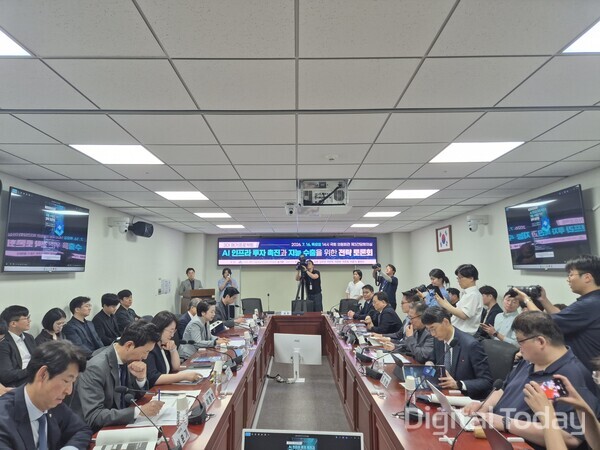
[DigitalToday reporter Seul-gi Son] The National Assembly Science, ICT, Broadcasting and Communications Committee in the second half of the 22nd parliament has selected AI infrastructure as its first joint policy agenda. It will identify legislative and institutional tasks to support the government’s "three mega-projects".
Song Gi-heon (송기헌), chair of the committee, said at a strategic forum on July 16 at the National Assembly Members' Office Building in Seoul that the committee and the government "must compile key tasks and move to the next stage."
The forum was jointly hosted by 10 committee members from the Democratic Party, including Song. Attendees included floor spokesman Han Jun-ho and lawmakers Hwang Jung-a, Lee Jeong-heon, Lee Ju-hee and Lee Hun-gi.
The three mega-projects are state-led initiatives that aim to help South Korea become a global power in AI and advanced industries. They focus on semiconductors, physical AI such as AI robots, and AI data centers. The government supports large private-sector investment plans by providing infrastructure such as power, water and land, as well as fiscal and institutional support.
In AI data centers, SK, GS and Naver will invest about 550 trillion won in a first-phase project to build facilities with a capacity of 8.4 gigawatts by 2029. The government plans to expand the total capacity to 18.4 gigawatts by 2035.
Calls for faster permits and a dedicated organisation
Companies attending the forum asked for shorter permitting timelines, expanded tax support, the establishment of a dedicated organisation and improvements to overlapping regulations as key tasks to speed up AI infrastructure investment.
Yoon Sung-eun (윤성은), head of SK Telecom's Comm Center and president of its AI Policy Research Institute, defined AI data centers as an industry that produces and exports intelligence by inputting electricity and data. Yoon said it was a core project to transform the country from importing and consuming AI to producing and exporting it. He said the legislative intent of a special law should be maintained as subordinate systems such as enforcement decrees are prepared. He also proposed on-site power demonstrations for overseas expansion.
Do Hyun-soo (도현수), head of GS AI Infrastructure, said customers typically want data centers that can begin operating within 2 years, but administrative procedures such as changing the use of industrial complexes take considerable time. He also cited long-lead equipment such as transformers and emergency generators as factors that delay construction schedules. He said regulations should be applied flexibly by usage because AI training and inference data centers differ from existing cloud data centers.
Bae Sung-joon (배성준), executive director at Naver Cloud, proposed expanding investment tax credits and allowing accelerated depreciation, given that spending on computing equipment such as GPUs outweighs investment in data center buildings. He also suggested forecasting public and private GPU demand together and consolidating purchasing power at the national level.
Lee Chang-jae (이창재), an executive director at Samsung SDS, asked for the creation of large-scale regional AI data center clusters and support for localisation of power and cooling equipment. Lee said, "Unfortunately, there is no dedicated department for AI data centers," and called for a separate dedicated organisation within the Ministry of Science and ICT and improvements to inspection regulations imposed on data centers in overlapping ways.
The government said it would review industry requests through an inter-ministerial consultative body and a public-private cooperation framework.
Kim Kyung-man (김경만), director general for AI Policy at the Ministry of Science and ICT, said AI data centers are an industry that combines IT equipment, power, cooling facilities and cloud operating technology. He said the government would pursue localisation of related parts and equipment and work to secure operating technology and specialised personnel.
Kim said the government would hold a working-level inter-ministerial task force once a month on a regular basis and run it as needed when issues arise. He said it also plans to launch an AI data center alliance involving companies, the Telecommunications Technology Association and the Korea Data Center Council to discuss tasks by field.
Committee members said they agreed on expanding AI infrastructure investment and urged the Ministry of Science and ICT to serve as an inter-ministerial control tower. They cited the need to coordinate among relevant ministries, including the Ministry of Land, Infrastructure and Transport for land and permits, the Ministry of Climate, Energy and Environment for power and water, and the Ministry of Trade and Industry and the Ministry of Finance and Economy for industry and tax policy.
Lawmaker Hwang Jung-a (황정아) said, "We will list items where there are overlapping regulations, discuss them together, and if necessary, we will have lawmakers introduce a revision bill." Hwang asked the ministry to lead the inter-ministerial task force and to report discussion results and follow-up actions regularly to the committee.
Song asked why allowing direct power purchase agreements, or PPAs, for AI data centers outside the Seoul metropolitan area was excluded during discussions on the special law. He said it was necessary to first confirm whether the energy-policy ministry opposed it or whether coordination among ministries was insufficient.
After the forum, Song told reporters he wanted to hear "the history". He said the committee would set priorities and handle the issues because they would be difficult to resolve without inter-ministerial consultation.
 Seul-gi Son
sageson@d-today.co.kr
Seul-gi Son
sageson@d-today.co.kr