
[DigitalToday reporter Seulgi Son] "The success or failure of corporate AI transformation (AX) depends on defining the task, not on adopting AI. Companies need to clearly define the task they want to solve through AX and translate it into performance indicators such as revenue and return on investment (ROI)."
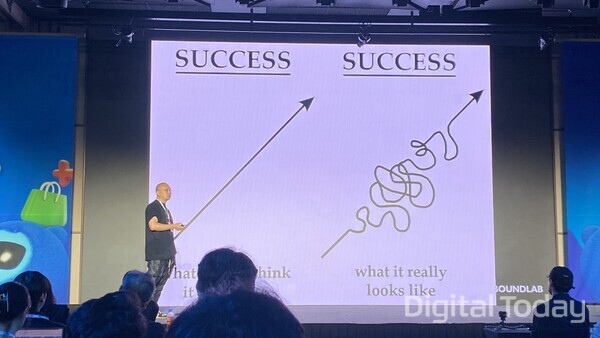
Cho Yong-min (조용민), CEO of UnboundLabDev, said at Salesforce Korea's 'Agentforce Digital Summit 2026' held at The Westin Josun Seoul Parnas in Seoul on Wednesday, "If the task is not defined, it is difficult to deliver results no matter how strong the technology is or how many experts are put in."
Cho is a venture capital investor who has invested in unlisted technology companies in the United States and South Korea. In his presentation, he introduced key investment cases including legal AI company Harvey as well as Anthropic, SpaceX, Viva Republica and Krafton.
He pointed out that when companies adopt AI, they often focus only on reducing existing work hours. He said tasks should be designed to improve higher-level business outcomes such as revenue, profitability and customer retention, beyond simply cutting time spent on drafting documents or searching for information.
Cho described this as a 'Level+1' KPI, one step above current departmental KPIs. He said companies should decide first what results the technology will deliver in the actual business, rather than treating AI functions or adoption rates as performance.
He cited two South Korean convenience store operators' 1+1 ordering AI as examples. Company A set its KPI as reducing disposal rates based on expiration dates and inventory. Company B set its KPI as increasing store owners' income by reflecting factors such as weather, trade areas and time slots.
Based on Cho's presentation, when Company B piloted the AI at some stores in Seoul's Gangnam area, disposal volume increased but store owners' monthly income rose to 18 million won from 10 million won. He described it as the result of setting the AI goal as boosting store income rather than inventory efficiency.
Legal AI company Harvey was also presented as a case of clearly setting business goals. Harvey is a vertical AI service used by U.S. lawyers. It supports lawyers' overall work, including legal research and document review and drafting.
Cho said applying a general-purpose model to some tasks is not enough. He stressed that it must be designed to fit industry-specific work structures and expertise to meaningfully raise on-the-job decision-making and productivity.
He also said reflecting company-specific data and work context is important. He explained that the AI industry has a structure that runs from infrastructure such as semiconductors and data centres, to hyperscalers supplying general-purpose models, to software specialised for industry-specific work.
He said companies should not stop at adopting general-purpose models, but should work with software companies that have accumulated data and business processes and with on-the-ground experts. Cho described the final stage of applying general-purpose models to link them to individual companies' work and performance as a 'last-mile solution.'
◆Hard to embed AI in daily work with only general-purpose adoption
In the panel discussion that followed, speakers introduced cases where adopting general-purpose AI tools did not lead to on-the-job use.
Based on Cho's presentation, a South Korean securities firm rolled out Copilot companywide, but after some time the usage rate was below 20 percent. The analysis was that it deployed the general-purpose tool first without deciding which tasks and decisions it would improve.
He said, "For initial interest in AI to translate into real use, companies must first decide what work to assign it," adding that the role of specialist partners who understand the industry and work is also important.
Kim Pyeong-ho (김평호), an industry advisor at Salesforce Korea, also pointed out that if an AI strategy is unclear, projects are likely to be halted at the proof-of-concept (PoC) stage.
He said, "Companies must clearly set what work AI will take on, how much it will raise employee productivity and how much it will contribute to corporate earnings," and added, "Only when companies quantitatively measure the AI agents they need and the ROI each creates can it lead to AX that both the field and management can accept."
 Seulgi Son
sageson@d-today.co.kr
Seulgi Son
sageson@d-today.co.kr