
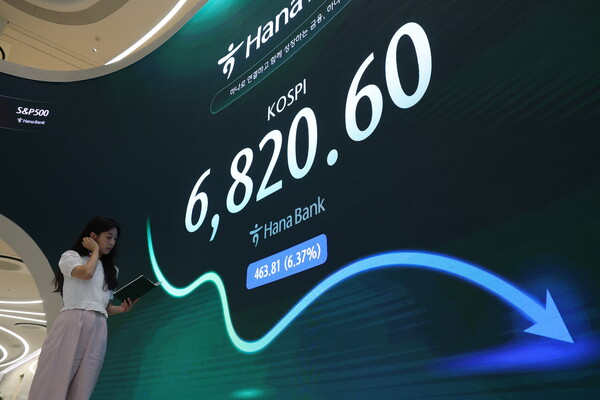
[Digital Today reporter Sang-yeop Oh] South Korea's KOSPI plunged more than 6 percent on heavy selling in semiconductor shares and joint selling by foreign and institutional investors. Sell-sidecar curbs were triggered in both markets.
On July 16, the KOSPI closed down 463.81 points, or 6.37 percent, at 6,820.60. The index opened down 323.91 points, or 4.45 percent, at 6,960.50 and widened losses to as low as 6,730.87.
In the main market, foreign investors posted net sales of 1.3761 trillion won and institutions sold a net 2.3666 trillion won. Retail investors bought a net 3.6581 trillion won, taking in supply.
Large-cap semiconductor shares led the decline. Samsung Electronics closed at 255,000 won, down 24,500 won, or 8.77 percent, from the previous session.
SK Hynix slumped 240,000 won, or 11.53 percent, to 1,842,000 won, falling back below 2 million won. SK Square fell 12.30 percent and Samsung Electro-Mechanics dropped 9.62 percent.
Elsewhere, Hyundai Motor fell 2.07 percent, LG Energy Solution slipped 0.30 percent, Samsung Life dropped 1.93 percent and KB Financial fell 0.28 percent. Samsung Biologics rose 0.94 percent.
The Korea Exchange triggered a sell-sidecar, a temporary halt to the effectiveness of program sell orders, in the main market. The number of KOSPI sell-sidecar triggers this year rose to 19, the fifth time this month.
A sell-sidecar was also triggered in the Kosdaq market. The Kosdaq closed down 37.59 points, or 4.53 percent, at 791.84.
The Kosdaq weakened from early trading and widened losses, slipping back below 800 in a day. Profit-taking selling emerged, centered on semiconductor materials, components and equipment and robot shares.
The won was at 1,481.10 per dollar, down 7.40 won, or 0.50 percent, from the previous session. Despite the sharp fall in domestic stocks, the won strengthened amid the impact of a key rate hike and foreign investors' demand for currency conversion.
The Bank of Korea raised its policy rate by 0.25 percentage point to 2.75 percent from 2.50 percent. Still, an analysis said the direct impact on the stock market was limited as the possibility of a rate hike had already been largely priced in.
Overnight in U.S. markets, the Philadelphia Semiconductor Index fell 2.1 percent and Micron plunged 8 percent, further worsening domestic sentiment toward semiconductor investment.
The controversy over a halt to data center construction in New York, an initial public offering by China's ChangXin Memory Technologies (CXMT), and the possibility of easing bottlenecks in supplies of semiconductor equipment were seen as stoking worries that the memory cycle had peaked.
Kang Jin-hyeok (강진혁), a researcher at Shinhan Investment & Securities, said, "Selling pressure emerged after the previous day's sharp gains and doubts about the semiconductor cycle persisted, sending the artificial intelligence (AI) value chain including Samsung Electronics and SK Hynix sharply lower." He said, "As market noise repeats, investor fatigue is also rising."
 Sang-yeop Oh
yub@d-today.co.kr
Sang-yeop Oh
yub@d-today.co.kr