
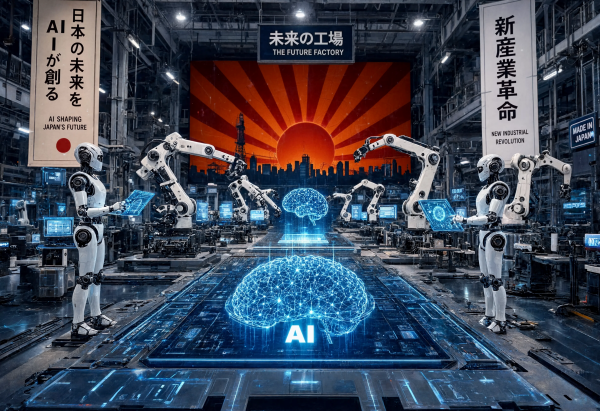
Fujitsu will work with FANUC, Yaskawa Electric and Kawasaki Heavy Industries to build a next-generation robot control platform using Nvidia's physical AI technology. The aim is to create a common control foundation that lets multiple robots move and make decisions together across industrial sites such as factories, logistics and healthcare.
Japan's ITmedia reported on Wednesday that Fujitsu, FANUC, Yaskawa Electric and Kawasaki Heavy Industries have begun studying a joint business for social application of physical AI using Nvidia technology. The core of the cooperation is to build an autonomous control foundation so that robots and equipment from different manufacturers can collaborate under a single common control system.
Fujitsu plans to apply AI models that make up Nvidia's physical AI platform and a "world model" that digitally recreates real environments to the common control system to raise automation levels at industrial sites. It will use Nvidia's world model platform, Cosmos, to simulate real factory and logistics environments and strengthen robots' ability to understand and predict surrounding situations.
For robot training and verification, it will use Nvidia's development platform Omniverse, the robot development framework Isaac and the physics engine Newton, among others. Fujitsu aims to raise development efficiency and realise an autonomous control system in which robots and equipment from multiple manufacturers operate together.
The scope will expand beyond manufacturing to logistics and medical fields. In factories, it will pursue optimisation of production planning and automation of on-site responses, and in distribution and logistics it will review automation of transport tasks reflecting inventory and sales conditions. In healthcare, proposed use cases include in-hospital transport of medicines and specimens, and automation of outpatient registration and guidance.
Fujitsu plans to broaden the application to other industries. The project will also combine robotics, control and simulation technologies held by each company. The ultimate goal is to build an autonomous control system that can integrate and operate robots and industrial equipment from different manufacturers on a single platform.
Fujitsu said it will develop a coordination control foundation that can be controlled within Japan to prepare for cyber attacks and system failures, and provide it as an open platform to companies and research institutions that agree to it.
The cooperation is also seen as an attempt to combine Japan's mechatronics strength in manufacturing with Nvidia's physical AI. At a press conference held the same day, Nvidia Chief Executive Jensen Huang (젠슨 황) said, "The next industrial revolution will be 'made in Japan'," and stressed the potential for combining Japan's accumulated mechatronics technology with Nvidia's AI platform.
The industry also sees the project as potentially reshaping automation approaches across industrial sites beyond a simple technology demonstration. Fujitsu also presented a plan to expand the common control platform into an open ecosystem rather than limiting it to its own technology. Attention is on whether Japan's robot industry can shift from a focus on individual equipment to integrated autonomous control systems that enable collaboration among manufacturers.
 Jinju Hong
hongjj@d-today.co.kr
Jinju Hong
hongjj@d-today.co.kr