
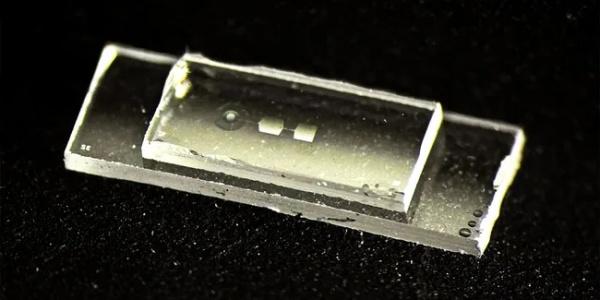
A new design has been unveiled for a fingernail-sized quantum chip that stores information using tiny mechanical vibrations. The researchers proposed a structure that could expand a quantum computer's working memory by applying the principle of vibrating guitar strings, suggesting the feasibility of next-generation quantum memory.
On July 16 local time, IT outlet TechRadar reported that a research team at Switzerland's ETH Zurich developed a new quantum chip architecture that separates quantum computation from information storage.
The quantum physicist leading the research, Lee Won Chou (이원 추), proposed a method to store and process quantum information using tiny mechanical vibrations that far exceed the range of human hearing.
The core is that, unlike existing quantum computers, it is designed so that computation and memory are handled by different devices. As a classical computer divides roles between a central processing unit (CPU) and memory, the researchers focused on implementing that structure inside a quantum chip as well.
A superconducting transmon qubit serves as the chip's CPU. Working memory is handled by an HBAR (High-Overtone Bulk Acoustic Resonator). Multiple vibration modes exist inside the HBAR, and each works like a memory slot. The qubit reads quantum information from a vibration mode, performs computation, and then stores the information back in that vibrational state.
The researchers likened it to guitar strings. As guitar strings produce different notes depending on how they vibrate, the HBAR can also use different vibration modes as independent storage spaces for quantum information, they explained.
This approach differs from existing quantum computer designs. Many current quantum computers handle computation and memory in similar structures, but this research proposes separating storage and calculation to improve memory efficiency.
Miniaturisation is also cited as an advantage. The researchers said the wavelength of acoustic waves is about 100,000 times shorter than that of electromagnetic waves, allowing far more memory structures to be integrated into the same space. While a full quantum computer still requires a large system, they said the structure is advantageous for increasing memory density inside the chip.
Basic performance verification was also carried out. The researchers succeeded in using the new chip to run the quantum Fourier transform and a period-finding algorithm, which are often used to evaluate quantum computer performance. They said this confirmed not only the concept but also the possibility of actual operation.
The ultimate goal is to implement quantum random access memory (QRAM). QRAM is cited as one of the key technologies for efficiently using quantum memory on a far larger scale than now. The researchers said that, for actual commercialisation, scalability of memory and computing performance must be secured at the same time.
The research is meaningful in that it suggests a way to address the memory problem, one of the biggest constraints in quantum computing, through a new approach. The ETH Zurich team proposed a structure that can sharply increase the number of memory slots using small acoustic resonators. It remains a key task whether this technology can be expanded to larger-scale quantum systems.
 Jinju Hong
hongjj@d-today.co.kr
Jinju Hong
hongjj@d-today.co.kr