
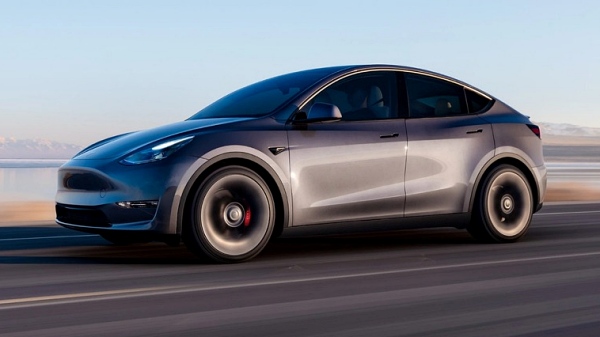
[Digital Today reporter Jinju Hong (홍진주)] Tesla's 0 percent vehicle financing offered in the United States is being interpreted as a sales promotion strategy in which the company effectively pays the buyer's interest costs. It delivers a discount effect worth several thousand dollars to consumers without directly cutting the sticker price.
Cleantechnica, an electric vehicle outlet, reported on Tuesday that Tesla is offering 0 percent or 0.99 percent instalment financing in the U.S. market to expand vehicle sales and reduce inventory.
In a high-rate environment like the current one, interest-free loans are not easily offered as a matter of course. The U.S. Federal Reserve's benchmark rate is around 3.50 to 3.75 percent, and the prime rate, a benchmark for major lending rates, is 6.75 percent. Typical auto financing rates are also in the 6 to 7 percent range.
That means someone must cover the interest costs that would be paid to the finance company for consumers to buy a vehicle at a 0 percent rate. Cleantechnica analysed that Tesla is subsidising those costs, creating an effective price-cut effect while keeping the official vehicle price unchanged.
The savings from financing terms are significant. Borrowing $40,000 for 5 years at an annual rate of 7 percent results in total interest of about $7,523. A $35,000 loan under the same terms requires about $6,583 in interest. Even at 6 percent a year, borrowing $35,000 results in about $5,999 in interest on a 5-year maturity and about $6,879 on a 6-year basis. When Tesla provides 0 percent financing, buyers save those amounts and Tesla bears corresponding costs.
That creates a similar perceived effect to officially cutting the vehicle price by $6,000 to $7,000. For consumers, the benefit comes not as a discount but as lower monthly payments and reduced total interest. Cleantechnica said Tesla is offering 0 percent and 0.99 percent financing together to stimulate demand without damaging the sticker price.
The strategy also ties in with Tesla's recent decline in profitability. With profit per vehicle shrinking in recent years, Tesla has combined price cuts with inventory discounts, free options and financing benefits to boost sales. It is against that backdrop that Tesla is using financing terms to provide an effective discount rather than sharply cutting prices again.
Current terms shown on Tesla's website also appear looser than in the past. Previously, conditions were discussed that buyers had to make a down payment of 15 to 20 percent of the vehicle price or purchase the Full Self-Driving software, known as FSD, to qualify for 0 percent financing. Now, the Model Y priced at $39,990 shows a down payment requirement of about $3,300. The standard loan term is 72 months, and consumers were introduced as being able to choose a shorter term or extend it up to 84 months.
With 84-month long-term financing, the value of the interest-free benefit becomes larger. The outlet mentioned interest savings of about $7,222. For consumers, it is a benefit similar to a dealer directly cutting more than $7,000 off the vehicle price. The outlet analysed that Tesla's reason for choosing financing subsidies over direct price cuts is related to defending profitability. For example, directly selling a $39,990 vehicle for about $32,770 would immediately lower the vehicle selling price and gross profit in accounting terms. Depending on the vehicle's cost, the possibility of a loss could also increase.
By contrast, financing subsidies can keep the official selling price while spreading the cost over a certain period. It said using cash resources to pay consumers' interest on their behalf could be easier to manage than a direct price cut.
Still, interest-free financing is ultimately a cost Tesla must bear, and if maintained for a long time it could pressure profitability. If sales do not rise enough, only the cost of financing subsidies could grow, and even if a sales recovery succeeds, profit per vehicle could decline. Tesla needs to find a balance between expanding sales and defending profitability.
Ultimately, Tesla's 0 percent financing is less like a free loan and closer to a promotional strategy in which the company discounts interest instead of the vehicle price. The key question will be whether such financing benefits lead to an actual sales recovery, and how long Tesla can sustain interest subsidies worth several thousand dollars.
 Jinju Hong
hongjj@d-today.co.kr
Jinju Hong
hongjj@d-today.co.kr