
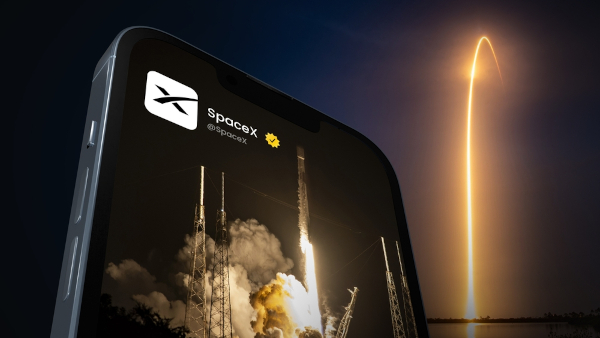
[Digital Today reporter Jinju Hong] An analysis said SpaceX's orbital data centre, which it envisions as future AI infrastructure, is technically feasible but must overcome multiple challenges including launch capacity, cooling, costs and latency before it can be commercialised.
According to IT outlet Ars Technica on July 15 (local time), SpaceX's space data centre concept does not require new laws of physics, but the biggest challenge is building an unprecedentedly large satellite constellation and launch system.
SpaceX views the orbital data centre as a core long-term growth engine rather than its rocket business. The company has presented a plan to operate 1 million satellites producing a total of 120 GW of power and to use tens of millions to up to 100 million advanced GPUs for space data centre services.
Elon Musk and SpaceX's head of satellite engineering, Ian Dall (이언 달), first introduced the AI1 plan for a first-generation orbital data centre satellite in a video released in June. Musk said the project does not require “magic technology that does not exist” and that it can use much of the technology applied to Starlink V3 satellites.
He cited a drastic reduction in launch costs for the next-generation super-heavy launch vehicle Starship as a prerequisite for the project. Ars Technica analysed that one AI1 satellite could supply average computing power of about 120 kW through solar panels of around 600 square metres.
The problem is weight. The solar panels alone are estimated at 1 to 2 tonnes, and radiators that emit heat into space are also expected to weigh at least 1 to 2 tonnes. Including the satellite body and GPUs, the weight of one satellite could reach about 3.5 to 7.5 tonnes.
A super-heavy reusable launch vehicle is essential to carry them into low-Earth orbit. SpaceX is considering boosting Starship V3's low-Earth orbit payload capacity to about 100 tonnes and expanding it to 200 tonnes in the next V4. The outlet assumed an ideal Starship launch cost of $20 million. That would put low-Earth orbit transport costs at about $100 per kg, but it remains unclear whether such a fully reusable system can be realised in practice.
Maintaining the satellites would also be costly. SpaceX is known to expect each satellite to have an operating life of about 5 to 7 years. Assuming a five-year life, maintaining a constellation of 1 million satellites would require thousands of launches each year. Even on an optimistic calculation, 10 Starship launches a day would be needed, and on a conservative estimate, 42 a day. There were 329 orbital launches worldwide last year, of which SpaceX carried out about 170. If space data centres become reality, it would mean at least a 20-fold increase in launch capacity from current levels.
Project costs would also be vast. Market research firm Quivalas estimated the manufacturing cost of one Starlink V3 satellite at about $1 million. But AI1 would need to carry large solar panels and high-performance GPUs, making actual manufacturing costs likely far higher. Including the cost of building a global ground communications network, some forecasts say the overall project could reach several trillion dollars.
The biggest technical challenge is cooling. Terrestrial data centres can use convective cooling with air, but in space heat can only be released through infrared radiation.
That would require large radiators and a cooling-fluid circulation system. The International Space Station uses more than 6 tonnes of radiators to handle about 70 kW of heat. But critics say applying the same approach to a large satellite constellation would be too burdensome in weight and cost.
Former SpaceX physicist Sam Waldman said the current form of Starlink satellites is designed to maximise heat-radiating surface area, and he assessed that SpaceX has sufficient related data. By contrast, Starcloud co-founder Philip Johnston said radiators of the existing space-station type are “expensive and heavy” and explained that the focus is now on developing low-cost, lightweight heat-radiation technology.
Radiation was assessed as a relatively solvable problem. SpaceX is known to have confirmed through its Starlink operating experience that key computing components such as GPUs and memory have significant radiation tolerance. Starcloud said it mounted an Nvidia H100 GPU on a test satellite last year and tested it in the space environment, adding that it has operated normally so far.
Communications delays could be a constraint depending on the type of AI work. Distances between satellites can range from tens of metres to several kilometres, which could be disadvantageous for large-scale AI training that requires real-time synchronisation of thousands of GPUs. By contrast, AI inference tasks that require less synchronisation may be better suited to space data centres. Because there is also communications latency between Earth and space, it forecast limits for ultra-low-latency services such as cloud gaming.
In the end, the orbital data centre is feasible in principle, but assessments say there are still many hurdles because commercialisation of super-heavy reusable launch vehicles, mass production of large numbers of satellites, low-mass heat-radiation technology and cost reductions must be achieved at the same time.
If SpaceX moves ahead with an actual launch of an AI1 satellite, those technical and economic assumptions are likely to be tested in the real world.
 Jinju Hong
hongjj@d-today.co.kr
Jinju Hong
hongjj@d-today.co.kr