
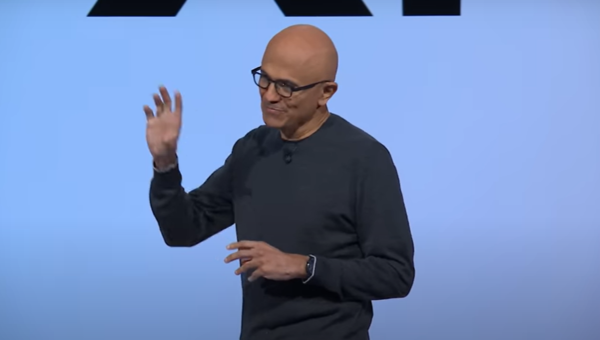
[DigitalToday reporter Chi-gyu Hwang] Satya Nadella (사티아 나델라), chief executive of Microsoft, has drawn attention after publishing a provocative post warning that companies cannot protect core intellectual property if they rely too heavily in the AI era.
In a recent post on social media platform X (Twitter), he stressed, "If AI model training flows only one way, economic value concentrates with those who have training infrastructure. It does not go to those who created the actual knowledge. Training infrastructure should be shared with all companies so each can control its own learning loop."
According to him, AI model providers are recognized as having the right to use public data for training. But they place limits on customers extracting and using their own data, or distillation. At the same time, they keep trying to hold on to the right to train their models on usage data left by customers.
In the post, Nadella also cited the "information paradox" described by Nobel economics laureate Kenneth Arrow.
According to Arrow, a buyer of information cannot know its value until it is checked directly. But once it is checked, it is effectively obtained for free. For the seller, the structure is that it is taken the moment it is shown in order to sell it.
But in AI, the situation plays out in reverse. In AI, the buyer is the one put at risk. To use what is bought properly, the buyer must give up the knowledge it has.
He said, "When you use AI, you effectively pay twice. Once with money, and another time with something more valuable. That is the company-specific knowledge provided to make the model useful."
As time passes, the information gap tilts to one side. Nadella said, "A company using AI hardly knows what the model is learning. By contrast, the side building the model learns more and more about that customer the more the customer uses it." He called this the "Reverse Information Paradox." He also said, "The patent system solved part of the paradox Arrow talked about. It created a way for inventors to disclose without simply giving away their ideas. The reverse information paradox also needs a corresponding mechanism."
What he focuses on is that data protection alone is not enough. Models also learn from traces people leave. This includes prompts, tools used by agents and, in particular, the process of people correcting model errors.
Nadella said, "Each time an employee corrects an AI error one by one, the correction accumulates as know-how only that company knows. Competitors cannot buy this knowledge even with money. But to the model provider, each trace, each correction and each evaluation leaks out without the company even knowing." He added, "The process of using AI itself is a process of creating new intelligence. What is created there should belong to that company."
Nadella also cited comments by Palantir CEO Alex Karp. Karp earlier wrote on X, "What customers who handle technology want is control over their own computing resources, models, data stack and alpha. They want the assurance that they have not handed the means of production to others."
Nadella said the current structure is creating the very situation Karp worries about. He added that companies need a clear trust boundary if they are to grow human capital and token capital together. There needs to be a space to gather organisational data, conversation records, evaluation results, adjusted model weights and accumulated memory in one place, manage them safely and keep improving them. He described this boundary as "a firm line that nothing crosses without consent" and predicted, "Going forward, companies will demand the right to fine-tune or train their own models using outputs produced by the model."
 Chi-gyu Hwang
delight@d-today.co.kr
Chi-gyu Hwang
delight@d-today.co.kr