
The Broadcasting Media and Communications Commission will upgrade its response system to false and manipulated information based on the revised Information and Communications Network Act. It will strengthen accountability for large platforms and also push to set up a transparency centre to support fact-checking activities.
It will introduce a labelling scheme for AI-generated material distributed online and prepare measures to raise transparency of recommendation algorithms. With false and manipulated information and AI-generated content increasing, it aims to help users choose information they can trust.
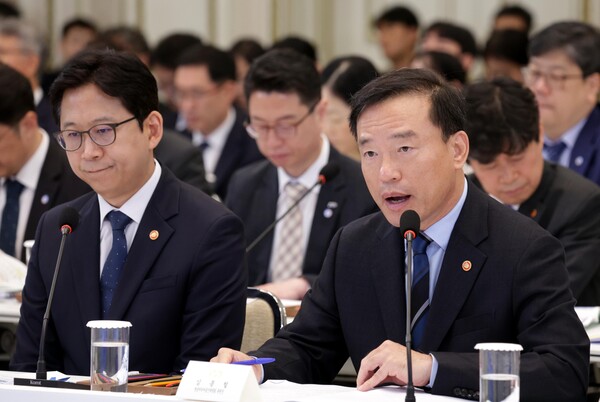
The commission reported to President Lee Jae-myung on July 16 on key achievements in the first half of 2026 and policy directions for the second half, including these plans, at the Cheong Wa Dae State Guest House.
As its policy vision for the second half, the commission presented a "basic media society" that guarantees the public's media sovereignty. It is a plan to guarantee everyone's right to participate in and access media, and to choose media that are safe and reliable.
Commission chair Kim Jong-cheol (김종철) said, "Media are an essential foundation that supports the daily lives of the public and society as a whole." He said, "We will realise a basic media society that substantively guarantees everyone's right to participate in and access media and choose media that are safe and reliable."
◆ Push for revised Information and Communications Network Act to take root, strengthen platform accountability
The commission will pursue stable implementation of the revised "Act on Promotion of Information and Communications Network Utilization and Information Protection" as a key task for the second half.
Earlier, in line with the act's implementation, the commission revised subordinate regulations covering the scope of application and procedures for reporting, receiving and handling false and manipulated information, and prepared guidelines for operators. In the second half, it will upgrade the response system to raise platform operators' accountability and to activate fact-checking activities by large-scale information and communications service providers.
It will also push to set up a transparency centre to support fact-checking by large platforms. The transparency centre is an organisation designed to help large platform operators verify facts. When large platform operators such as Naver and Kakao receive reports of illegal or false and manipulated information, they can take action under their own operating policies or seek help from external fact-checking organisations with which they have agreements. At present, only 1 domestic organisation has been certified by the International Fact-Checking Network (IFCN), JTBC.
The transparency centre budget will be secured through reserve funds. Shin Young-kyu (신영규), director general of the commission's Broadcasting and Communications User Policy Bureau, said at a pre-briefing on July 15 that it plans to establish the transparency centre with reserve funds and is pushing to secure a budget of 2.8 billion won.
On concerns that the transparency centre's establishment could be delayed, he said it is a principle that domestic operators make determinations under their own policies and guidelines. He said a structure will allow operators to receive support from the transparency centre if they feel burdened by fact-checking activities.
The commission is also proceeding with procedures to designate large-scale information and communications service operators in connection with the transparency centre. It notified platform operators believed to have at least 1,000,000 average daily users that they had been designated. Domestic operators designated as large-scale information and communications service operators were Naver, Kakao, Nate, AXZ and DC Inside, while overseas operators were Google, Meta, X and TikTok.
The commission recently requested a separate explanation from DC Inside. Shin said DC Inside was believed to have about 4,000,000 average daily users and the commission asked for an explanation. He said it received materials on July 15 and will review them to determine whether to make a final designation.
◆ Push AI-generated content labelling and algorithm transparency
Alongside its response to false and manipulated information, it will also prepare measures to raise transparency of AI-generated content. The commission will push to introduce an "AI-generated material labelling scheme" requiring AI-generated material distributed online to indicate that it was generated. The aim is to enable users to judge information while recognising how the content was created and its source.
It will also revise related laws and systems so that users can understand the influence of recommendation algorithms in the process in which specific information is repeatedly exposed to users or spreads.
It will also push a unified media legal framework covering broadcasting and online video services (OTT). It will systemise laws related to broadcast media that are dispersed by medium and build support and promotion systems so that diverse media such as broadcasting and OTT can coexist.
Measures to prevent distribution of illegal recordings will be expanded from videos to images. It will also conduct on-site inspections to check whether information and communications service providers are properly fulfilling their obligations for technical and managerial measures. It will also push to introduce an emergency blocking right to quickly block illegal information such as drugs and to upgrade illegal information blocking technology.
◆ Review regulation of youth SNS use, push legislation in parliament
The commission is also reviewing regulation related to youth use of social network services (SNS). It will pursue legislation in parliament by examining multiple measures, including strengthening obligations for operator identity verification and age verification, and requiring parental supervision and management functions.
It will also expand the public's rights to participate in and access media. It will strengthen tailored media education and AI response capability education reflecting characteristics across the life cycle, and prepare procedures for the public to participate directly in policy processes such as support for programme production and blocking illegal and harmful information.
It will expand the scope of guaranteed media access rights from the visually and hearing impaired to all people with disabilities. It plans to establish a comprehensive media inclusion plan and revise systems including grounds to support production of disaster broadcasting, so that needed information can be used in a timely manner regardless of disability status.
It will also expand support for producing locally focused programmes and build cooperation systems among local broadcasters, AI companies and universities. It will foster young creators and expand regional media hubs and viewer media centres.
◆ Prepare pay-TV regulatory improvement steps, follow-up measures after handset subsidy law repeal
To restore the broadcasting industry's competitiveness, it will also improve regulations on ownership and cross-ownership and on advertising and scheduling. It will establish a strategy to promote pay-TV media and also push to ease regulations on broadcast advertising and sponsorship. A commission official said it has formed a study group with pay-TV operators to gather industry opinions and will announce policies for pay-TV promotion and institutional improvements.
A proposed revision to the enforcement decree of the Broadcasting Act to ease advertising regulations is currently in the legislative notice stage, and follow-up work is under way on a parliamentary bill to shift broadcast advertising to a negative regulation system. It is also preparing measures to innovate sponsorship regulations.
Follow-up measures after repeal of the Mobile Device Distribution Act will also be submitted as a commission agenda item. The commission has formed a consultative body of operators and is preparing follow-up measures reflecting stakeholder opinions.
It is also consulting with relevant ministries on establishing a Broadcasting Media and Communications Promotion Institute and adjusting which agency oversees OTT policy. Sung Jong-won (성종원), the commission's planning and coordination officer, said the bill to establish the institute has been submitted to the National Assembly's Legislation and Judiciary Committee. He said OTT involves multiple ministries and the commission is communicating frequently with relevant ministries including the Prime Minister's Office, the Ministry of Science and ICT, and the Ministry of Culture, Sports and Tourism.
◆ Step up efforts to restore broadcasting public interest, signal launch of media development panel
The commission said that in line with implementation of the revised three broadcasting laws in the first half of the year, it revised enforcement decrees and rules and 마련했다고 explained that it built an institutional foundation supporting diversity and independence of public broadcasters' boards and autonomy in reporting and scheduling.
It completed nominations for appointment of 4 KBS directors and appointments of 8 directors each for the Foundation for Broadcast Culture and EBS. It also proceeded with recommending directors to normalise TBS and allowing commercial advertising, and carried out deliberation procedures and legal advice related to YTN.
The commission will make 2027, marking 100 years of Korean broadcasting, a starting point for preparing a new 100 years of broadcasting media and communications. It will 추진 and push projects to commemorate 100 years of broadcasting and will first review holding the "2027 Asia Media Summit" in the regions. It also plans to launch a social public deliberation body, the "Media Development Committee", after consultations with relevant ministries.
In particular, in the second half it plans to speed up establishment of an affiliated "Korea Broadcasting Media and Communications Promotion Institute" to strengthen functions to promote the broadcasting and media industry. Chair Kim said it is pushing legal revisions aimed at integrating and reorganising public institutions so that the commission can play its role in an era centred on new media. He said the related bill has been submitted to the Legislation and Judiciary Committee and he will move to pass it quickly to meet expectations.
Meanwhile, the commission has yet to appoint a standing commissioner allocated to the opposition party. The seven-member consensus body is currently operating with 6 members. As a result, the post of vice chair, which is elected by the members, also remains vacant. The commission is waiting for parliament to recommend an opposition standing commissioner.
On the day, President Lee again urged an active response to false and manipulated information. Lee said in the work report, "Please make efforts so that we can respond thoroughly to and prevent the distribution of illegal and false and manipulated information." He said, "It seems the role of a regulatory agency really needs to be done very well in response to people exploiting false fake information to pursue private gain or trigger social division and conflict."
 Jin-ho Lee
jhlee26@d-today.co.kr
Jin-ho Lee
jhlee26@d-today.co.kr