
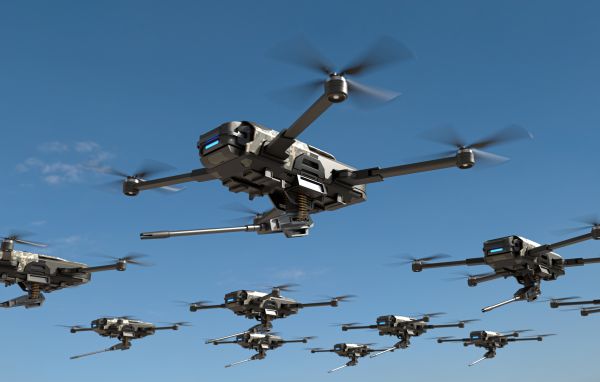
Europe is rapidly shifting its security investment focus toward drones and autonomous systems.
On July 15, local time, CNBC reported that the trend has become clear over the past two weeks with a new NATO drone initiative, a multibillion-pound UK investment, Germany's large-scale procurement of drones for Ukraine and a major valuation for German defence technology startup Helsing.
The crux is that drones are no longer an auxiliary force but are being reshaped as core equipment in modern warfare. European countries have continued to rebuild their militaries since Russia's invasion of Ukraine, and are focusing on relatively inexpensive drones equipped with artificial intelligence that can handle reconnaissance, strikes, extending the range of existing weapons and autonomous operations.
NATO last week formalised strengthening alliance-wide capabilities to respond to drones. NATO Secretary General Mark Rutte (마르크 뤼터) announced a plan to invest more than $40 billion, or about 59.5 trillion won, in counter-drone capabilities over the next five years and said NATO would become a military alliance that is "ready for drones". He said drones have fundamentally changed the nature of modern warfare and have become a "decisive factor" on the battlefield.
Britain is also accelerating investment in autonomous systems. In a defence investment plan announced in late June, the British government decided to put 5 billion pounds, about 10 trillion won, into the "UK Drone Transition" programme to strengthen military power. A feature is that major European countries are budgeting for both drones themselves and counter-drone systems together.
Germany is increasing actual procurement volumes along with expanding support for Ukraine. Defence industry and software company Auterion and Ukrainian drone maker SkyFall on July 14 announced they had received an order worth 90 million euros, about 154 billion won, for 50,000 drones equipped with Auterion's operating system from a European NATO member state. It was also confirmed that the country was Germany.
Lorenz Meier (로렌츠 마이어), Auterion's chief executive officer, assessed this war as the first in which drones, in a sufficiently supplied state, played a full-scale military role. He said software is taking on greater weight on the battlefield and explained that the company's operating system enables drones to push into targets even under radio jamming, boosting efficiency in a combat environment. It also includes a function to support strikes even if the target is below the radio horizon.
Auterion plans to introduce swarm control software that operates multiple aircraft together instead of having pilots fly each aircraft separately. The order is for Ukraine, but the militaries of Germany, Norway, Britain and France are also showing interest in the technology.
The market benefit is not limited to drone manufacturers. Morningstar analyst Loredana Muharremi (로레다나 무하레미) said future defence systems are moving to a layered battlefield. Tanks will not only fire shells, but also launch drones and move within a battlefield network by receiving real-time target information from satellites and unmanned aircraft. As a result, demand is also growing for secure communications for real-time command, battlefield management software, AI, satellite-based intelligence, sensors and electronic warfare systems.
Muharremi said companies exposed across autonomy, air defence, sensors, electronic warfare, software and space are likely to take a large share of future increases in defence spending. The approach of combining inexpensive drones with expensive weapons to disperse or saturate enemy air defences is also spreading, increasing demand across the broader ecosystem.
Capital flows also support the trend. McKinsey said core defence spending in Europe has doubled since 2019, and that considering NATO's 2035 target of 3.5 percent of gross domestic product, it could reach about 800 billion euros, about 1,400 trillion won, or about 2.9 percent of GDP in 2030. Investment in defence technology ventures also surged in 2025 on both sides of the Atlantic. European defence technology funding rose to 2.6 billion euros, about 4.44 trillion won, in 2025 from about 200 million euros, about 340 billion won, in 2021.
Against this backdrop, Helsing on July 14 secured a valuation of $18 billion, about 27 trillion won, with new investment. Helsing develops drones and underwater surveillance weapons, along with AI and autonomous software that run them. The trend of Europe's defence industry concentrating funding on the view that the future of war depends on software and autonomy, as well as traditional weapons systems, is becoming even clearer.
 Seung-a Yoo
ysah@d-today.co.kr
Seung-a Yoo
ysah@d-today.co.kr