
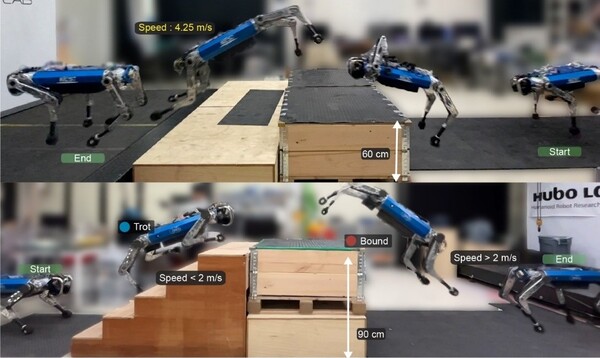
A quadruped walking robot technology has been developed that selects its own movement strategy based on the surrounding environment, such as changing its gait on stairs and jumping over gaps.
KAIST said on Wednesday that a research team led by mechanical engineering professor Hae-won Park (박해원) has developed core control technology for a quadruped walking robot that can select and switch in real time among various gaits such as walking, running and jumping using a single controller.
Because quadruped walking robots move using four legs, they are better suited to rough terrain than wheeled robots. But in real outdoor environments, different obstacles appear in succession, making stable movement difficult with only the ability to walk fast or run.
Existing quadruped walking robots had to control each gait separately, such as walking, running and jumping. That limited their ability to switch naturally between gaits as the environment changed.
To address this, the team developed a technology called "Action-Prior Training-based Transformer Reinforcement Learning (APT-RL)." The approach has the robot learn various gaits in advance, such as walking, running and jumping, and then combine and switch among them depending on the actual situation.
The team did not directly film the movement of people or animals. Instead, it used computer simulation to generate a total of 15.5 hours of gait training data in 8 minutes. It applied a dynamics model that mathematically represents the robot's motion and trajectory optimisation technology that calculates efficient movement paths.
The team then applied reinforcement learning, an AI technique that learns optimal actions through trial and error. That enabled the robot to choose appropriate gaits on complex three-dimensional terrain, including stairs, level differences, gaps and stepping stones.
It also combined a depth camera and LiDAR. The robot recognises its surroundings and target speed in real time and chooses the most suitable movement strategy among walking, running and jumping.
The team installed the technology on its self-developed quadruped walking robot, the KAIST Hound, and verified performance on an indoor obstacle course and at the KAIST campus and forest paths. The KAIST Hound switched gaits in real time while moving not only on urban-style terrain that includes stairs, grass and ramps, but also on irregular natural terrain such as fallen trees, exposed roots and leaf-covered paths.
On rough ground with obstacles, it recorded a peak instantaneous speed of 6 metres per second, or about 22 km per hour. Depending on terrain and target speed, it also selected and switched on its own between a "trot," which alternates diagonal legs, and a "bound," a leaping gait that uses the front legs together and the rear legs together.
Park said the study showed that quadruped walking robots can recognise complex and irregular indoor and outdoor terrain and select and switch gait strategies on their own to suit the situation. He said it would be a foundational technology that broadens the potential use of physical AI-based walking robots in rough environments such as disaster sites, defence missions and industrial facility inspections.
Researcher Jun-gil Kang (강준길) and Jae-hyun Park (박재현), a PhD candidate in KAIST's mechanical engineering department, participated as co-first authors. Park and Korea University professor Seung-woo Hong (홍승우) served as co-corresponding authors.
The results were selected as the cover paper for the July issue of the international robotics journal Science Robotics and were published on July 15, U.S. Eastern time.
 Jin-ho Lee
jhlee26@d-today.co.kr
Jin-ho Lee
jhlee26@d-today.co.kr