
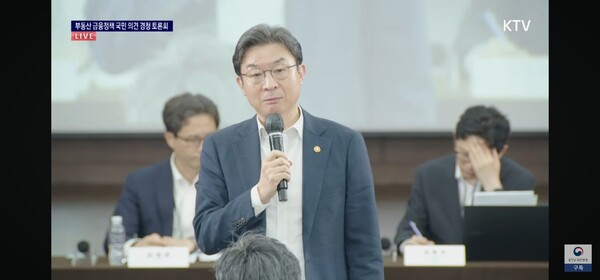
Kim Iuck-hyun (김이억원), chairman of the Financial Services Commission, said he will gather a range of opinions on property lending policy and reflect them in measures to manage household debt and protect end-users. Experts proposed differentiating real estate financial rules by supporting jeonse loans mainly for vulnerable groups and imposing separate charges on large loans.
In opening remarks at the “Public Forum to Hear National Opinions on Real Estate Finance Policy” held at the Korea Federation of Banks building in Seoul’s Jung-gu district on Tuesday, Kim said, “This is not a place to confirm that one side’s 주장 is right or to prove another claim is wrong.” He said it was a forum “to candidly 확인하고 listen to different views.”
Kim said authorities have pursued policies to curb lending demand for speculative purposes while also protecting housing opportunities for end-users.
“We have worked to ensure household lending is managed stably within what our economy can bear, and we have responded strictly to speculative loan demand, such as mortgage lending for multi-homeowners and the diversion of business loans for purposes other than intended,” he said. “We also pursued supplementary efforts in parallel to protect housing opportunities for end-users, including first-time homebuyers and users of policy mortgages,” he added.
Still, with the household debt ratio remaining high, Kim said the commission plans to gather views across real estate finance, including jeonse loans and housing supply, and reflect them in future policy.
“For policymakers, there are times when the concrete experiences and realities of each and every citizen provide more important answers than detailed statistics and systems,” Kim said. “We will listen to every opinion raised without遗漏 and examine them closely,” he said.
In the ensuing discussion, participants said selective management was needed that considers borrowers’ income, home prices and the purpose of borrowing, rather than uniform caps on total lending.
Kim Miru (김미루), a director at the Korea Development Institute, said, “Jeonse loan demand arises because the burden is lower than monthly rent.” She said that “increases the burden of price rises,” and argued that guaranteed jeonse loans should be supported only for vulnerable groups.
Kim Won-jang (김원장), vice president of SamproTV, said jeonse loans should be approached as housing welfare rather than as housing market regulation.
“Jeonse loans are not housing policy and should be approached as welfare policy,” Kim said. “The rental housing stock ratio remains only in the 6 to 7 percent range. Jeonse loans for vulnerable groups should not be tied up or reduced but expanded,” he said.
Participants also said the way household lending is managed should move away from quantitative regulations such as loan-to-value ratios, debt service ratios and overall lending caps, and be supplemented by imposing greater costs on borrowers of high-priced homes and large loans.
Kim Young-do (김영도), a senior research fellow at the Korea Institute of Finance, said, “Overall lending caps impose limits one way or another, but society is already complaining of various side effects.” He said, “You cannot solve everything with policies that only reduce the amount of lending.”
As an alternative, Kim proposed imposing macroprudential management charges on high-priced homes, multi-homeowners and large-loan borrowers.
“That could reduce excess demand for high-priced homes and ease the part where high-priced homes act as a catalyst leading prices,” he added.
 Ji-young Lee
ljy@d-today.co.kr
Ji-young Lee
ljy@d-today.co.kr