
[DigitalToday Seungah Yoo, intern reporter] SoftBank Group Chairman and CEO Masayoshi Son (손정의) said the spread of artificial intelligence (AI) means the era in which humans stand at the apex of living beings is over, and that the path to survival is for humans to evolve into “superhumans”.
On July 14 (local time), IT media outlet ITmedia reported that Son presented a 2040 roadmap for the AI industry and how humanity should respond in a special lecture at “SoftBank World 2026” held that day.
“The era in which humans are the apex species will end. It is not a matter of good or bad,” Son said, adding that humans must evolve along with AI. “Becoming superhumans is the way forward for us humans,” he said. He framed AI not as a simple productivity tool but as a structural change that alters humans’ standing.
He forecast that in 15 years, in 2040, the AI market will become a core pillar of the global economy. Son said artificial superintelligence (ASI) will account for about 20 percent of global GDP, with annual revenue reaching 7,000 trillion yen. He said companies with profit margins close to 50 percent could emerge in that market, generating annual profits of around 3,500 trillion yen and accounting for about 80 percent of total stock market capitalisation.
That outlook assumes the expansion of ultra-large infrastructure. Son said AI data centres will require 3 terawatts of electricity in 2040. He said that is about 1.8 times current global power use, calculated solely for data-centre electricity. He added that after 2040, demand for electricity will rise by 1 terawatt every year.
On power sources, he said gas-fired generation will be central for the time being, but that nuclear fusion will take the lead in 2040. Son said nuclear fusion is highly clean because it uses water as a raw material, adding that the planet’s carbon and warming problems “could disappear as if by a lie”.
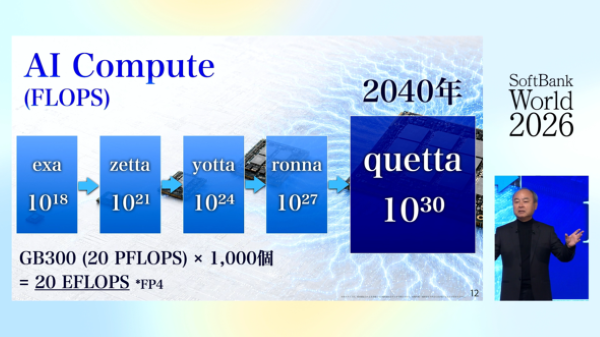
He also set out a view on computing power. Son cited the “quetta” unit, meaning 10 to the power of 30, as a 2040 benchmark for AI data centres. “People who do not know quetta should not talk about AI,” he said, stressing that discussions of future AI infrastructure must assume a far larger scale than today.
Investment needs are also huge. Son said building such infrastructure would require annual investment of $5 trillion. He said compute infrastructure, like railways and highways, is an area that needs long-term planning, adding that “you should not talk about infrastructure without thinking 15 years ahead”. He said that if a market worth 20 percent of global GDP generates annual revenue of 7,000 trillion yen, spending 800 trillion yen a year would still be sufficiently viable.
He rejected claims of overheated AI investment. Asked whether AI is a bubble, Son called it “a tremendously foolish question”. He said asking such a question stems from not understanding AI’s essence. He compared it to someone talking about airplanes without ever flying, or talking about cars without ever riding in one.
Son said he also uses AI in his daily life. “I am using AI right now from morning to night,” he said. He noted that during the internet revolution, companies that failed to take first place in their position within the first 20 years did not reach the top later, and he stressed that the AI revolution likewise requires a long-term strategy looking to 2040 from now.
These remarks draw attention for putting industrial-structure changes at the forefront that go beyond technology competition around AI to include power, data centres and long-term capital investment. Son said humans’ role should also be redefined toward augmentation rather than reduction, highlighting that competition in the AI era depends not only on adopting technology but on how quickly infrastructure and usage systems are built.
 Seungah Yoo
ysah@d-today.co.kr
Seungah Yoo
ysah@d-today.co.kr