
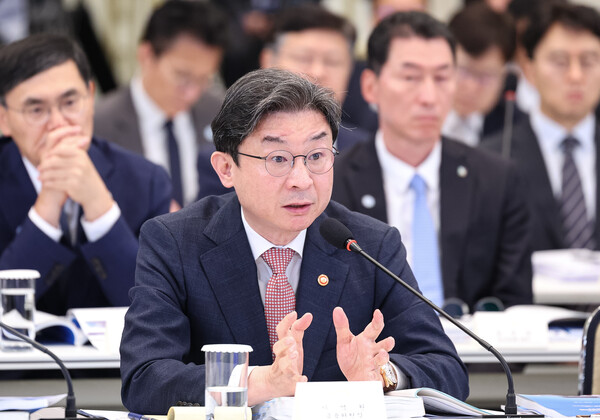
South Korea's Financial Services Commission will push a governance overhaul of the financial sector, including improving procedures for renewing chief executives' terms to block long-term control enabled by friendly boards. It will also speed up financial structural reforms to support productive finance and artificial intelligence transformation, including expanding the National Growth Fund to 200 trillion won and fully lifting network separation rules in the financial sector.
The FSC on Tuesday announced the direction of its financial structural reform drive in a joint second-half work report with related ministries.
Financial Services Commission Chairman Eok-won Lee (이억원) said he would move to step up and accelerate financial structural reforms supporting an “irreplaceable Korea.”
The FSC presented three key tasks for second-half financial policy: productive finance, inclusive finance and trusted finance.
CEO trench building blocked...renewal procedures improved
To improve fairness and transparency in financial company governance, the FSC said it would block at the source so-called “trench building,” in which a CEO forms a board friendly to the CEO and maintains management control for a long period.
It will also improve CEO renewal procedures. The aim is to prevent excessive concentration of authority in specific management by increasing transparency throughout the renewal process, including nomination, verification and board resolutions.
The FSC will also prepare reform measures to improve the overall financial administration and supervisory system, including inspections and sanctions and licensing and approvals for financial firms. It plans to announce detailed governance reforms and financial administration reform measures separately later.
To support AI transformation and work innovation in the financial sector, it will also pursue a full lifting of network separation rules. It plans to ease regulations so financial companies can make broader use of external AI and cloud services, while also overhauling the digital security regulatory framework.
It will also revamp the consent system for using credit information. The FSC plans to broaden the foundation for data use so financial companies can use AI and data technologies to provide inclusive financial services tailored to individual circumstances.
National Growth Fund expanded to 200 trillion won
The FSC will increase the size of the National Growth Fund from 150 trillion won to 200 trillion won to expand funding for advanced industries. It will also expand support targets from the existing 12 advanced industries to future strategic industries including aerospace.
It plans to expand the annual scale of equity investment support, under which the financial sector directly shares risks of advanced industry projects, from 3 trillion won to at least 5 trillion won.
It will also establish a new entity tentatively named Korea Strategic Technology Partners (KSTP) that focuses investment on national strategic technologies. Through this, it plans to supply up to 10 trillion won in long-term, large-scale investment funding for future foundational technologies and core technologies.
Since its launch, the National Growth Fund has approved a total of 14.6 trillion won in support for 21 projects over six months. A 600 billion won public participation fund launched in May sold out in 5 business days after sales began.
According to the FSC, the financial sector supplied about 150 trillion won to productive fields through May this year. It plans to encourage financial companies to expand organisations and staffing related to productive finance and reflect related performance in key performance indicators.
Regional policy finance expanded to 164 trillion won
It will also strengthen financial support for regional businesses and local industries. The government plans to expand the scale of policy finance supplied to regions, linked to its “5 hubs, 3 special zones” regional development strategy, from 100 trillion won in 2025 to 164 trillion won in 2028. The Korea Credit Guarantee Fund will provide preferential guarantees worth 1 trillion won to regional strategic industries.
To increase regional funding supply by private financial companies, it will enhance the discriminatory power of regional reinvestment assessments and publish a “productive finance fact book” that includes local finance performance.
It will also expand regional mutual growth programmes involving policy finance institutions, large companies and financial firms to encourage funding supply to regional small and medium-sized enterprises and partner companies.
In capital markets, it will launch a “three major structural innovation programme” to improve the fundamentals of the relatively undervalued KOSDAQ market.
It will strengthen crackdowns on market-disrupting activities such as illegal acts by finfluencers, and push a plan to shorten the stock settlement cycle from the current T+2 to T+1.
It will prepare a plan to pay interest on IPO subscription deposits and, in principle, ban duplicate listings. It will also push disclosure of low-price-to-book ratio companies and encourage listed companies to increase dividends.
New 1,000,000 won, annual 4.5 percent loan for low-income borrowers
It will also pursue institutional changes to embed inclusive finance as a constant management system at financial companies, rather than one-off support.
The FSC will set up a comprehensive evaluation system to assess financial companies' inclusive finance performance and push the introduction of a chief inclusive finance officer.
It will also establish a “Seomin Finance Stability Fund” to stably supply policy finance for low-income borrowers. It plans to use the fund to lower interest rates on policy finance products and expand supply.
It will also prepare a small-amount, low-interest, long-term loan product that links finance and welfare systems. The loan limit is 1,000,000 won, the interest rate is 4.5 percent a year and the maturity is 10 years.
It will continue to clean up long-term delinquent debt. It will collectively write off long-term delinquent debt of 20 years or more held by public financial institutions and strengthen management of the non-performing loan distribution and trading market.
The FSC said it bought 10.4 trillion won worth of long-term delinquent debt held by 885,000 people through the “New Leap Fund” in the first half of this year and immediately stopped collection.
It will also expand support for young people and small business owners. It will support asset formation through the “Youth Future Savings” product and supply policy finance products dedicated to youth entrepreneurship. From August, the “Small Business Specialised Credit Rating Model (SCB)” will be piloted for bank loans worth 2 trillion won. The “The Dream Package,” preferential funding for small business owners, will be expanded from 10.5 trillion won to 12 trillion won.
Household debt volume control to continue
The FSC plans to restrain a concentration of financial sector funds into real estate by strengthening capital regulations related to home mortgage loans while keeping overall household debt stably managed.
It will establish a financial stability account and introduce a rapid resolution system to respond preemptively to financial company insolvency.
It also plans to establish order in financial markets by building AI-based insurance fraud prevention infrastructure and strengthening anti-money laundering capabilities.
 Ji-young Lee
ljy@d-today.co.kr
Ji-young Lee
ljy@d-today.co.kr