
[DigitalToday reporter Lee Ho-jung] "The Zalpha generation selects content and services to fit its goals and takes part directly, rather than consuming them passively. Reading has expanded into recording and sharing, generative artificial intelligence (AI) into conversation and production, and mobile services into participatory and experiential use."
KT Millie's Library, MindLogic and IGAWorks on July 15 jointly held a media seminar at PR Bridge Storium in Seodaemun-gu, Seoul, titled "Trends in the first half of 2026 read through data: A new everyday life changed by the Zalpha generation," and presented data on reading, generative AI and mobile use.
The term Zalpha generation refers to both Generation Z and Generation Alpha, born from the late 1990s onward. It is classified as a generation familiar with digital content and personalised services, and marked by a tendency to participate and create directly rather than stopping at consumption.
RECORDS KEEP READING GOING... 440 MILLION HIGHLIGHTS
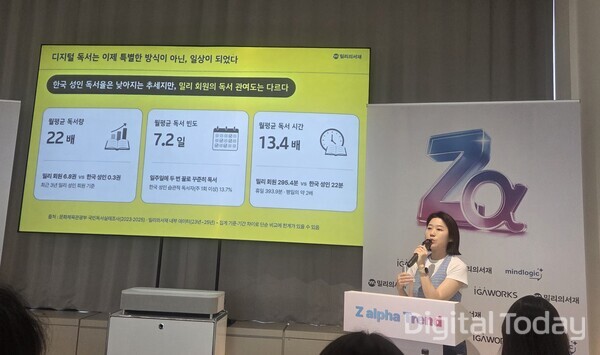
Lee Shin-hyung (이신형), head of the Unlimited Reading Team at KT Millie's Library, analysed the Zalpha generation's reading behaviour based on reading behaviour data accumulated over 10 years from 10 million members and usage data for 240,000 pieces of content.
A comparison of the Ministry of Culture, Sports and Tourism's national reading survey with Millie's Library internal data showed Millie's Library members read an average 6.8 books a month, 22 times the South Korean adult average of 0.3 books. Among Millie's Library members, those in their 20s and 30s accounted for the largest share at 54.6%, and teenage users are also trending upward.
Millie's Library analysed that in a video-centred environment, text consumption has come to be accepted as a way to express taste and identity, spreading a "text hip" culture in which readers post proof on social networking services (SNS) after finishing a book or share copying and highlights.
The same trend was confirmed in data on use of recording functions. Millie's Library's cumulative highlights totalled 440 million, and one-line reviews totalled 1,006,318. Members using recording functions read an average 9.8 books a month, 1.9 times more than the 5.1 books for non-users.
Members who began recording increased their monthly average reading from 6.2 books over the previous three months to 8.6 books in the first month, up 38%. Even six months after stopping recording, they read 7.4 books, sustaining a level 19% higher than before recording. Millie's Library interpreted recording as helping accumulate reading experiences and sustain habits.
Summary-format content also helped lower barriers to starting reading. Millie's Library offers audiobooks, chatbooks that reconstruct books in a chat format, and docent books summarised into 15-minute segments.
Members using summary content read an average 13.3 books a month, 2.1 times the overall member average of 6.4. Their average monthly days of access was 12.6, higher than the overall average of 9.2, and their continuous subscription rate was 3.3 percentage points higher than members who used only e-books.
CLAUDE SHARE 33.1%... AI ALSO CHOSEN BY PURPOSE
Kim Jin-wook (김진욱), chief executive of MindLogic, explained the Zalpha generation's AI use based on user data from the generative AI integrated platform FactChat.
FactChat allows access to more than 80 AI models, including 47 large language models (LLMs), 21 image generation models and 16 video generation models. It has secured 500,000 paid users, about 80% of whom are university students. It is currently used by 75 universities, 330 elementary, middle and high schools, and private and public institutions. Token usage in June was about 90 billion.
Kim explained that the Zalpha generation uses AI like an "operating system for work," not a search box. Rather than sticking with one AI, users switch brands and models depending on the purpose, such as writing, analysis and production.
By FactChat token usage, ChatGPT's share rose from 69.7% in July last year to 85.7% in September that year, then fell to 30.6% in June this year. Claude, by contrast, rose from 9.6% in July last year to 33.1% in June this year, surpassing ChatGPT in token usage share within FactChat. Gemini recorded 20%.
The scope of AI use also expanded from text to images, video and music. The number of images generated per user rose about threefold from 0.8 in July last year to 2.2 in June this year. The share of users of the video generation function increased 2.8 times from November last year to May this year.
How users talk with AI also differed from search. Based on FactChat's count, the average input per message increased 2.8 times, from 9,700 tokens in September last year to 27,100 tokens in June this year. About a quarter of all conversations involved exchanging 10 messages or more. Users continued tasks by adding materials and revising outputs rather than ending after getting an answer from a single question.
In June, 66% of FactChat users used two or more functions together. Kim explained that AI use expanded beyond simple question-and-answer to performing actual tasks such as attaching files and automatically generating PPT, analysing national statistical data and creating customised agents.
FROM AI CHATS TO SHOPPING AND FINANCE... MOBILE EVERYDAY LIFE RECAST
Yoo Kyung-won (유경원), head of enterprise marketing at IGAWorks, presented the Zalpha generation's mobile usage patterns based on data built on about 43 million advertising identifiers (ADID) held by the mobile data platform MobileIndex.
IGAWorks presented a "Zalpha concentration" metric that divides the share of Zalpha users among users of a specific app by the share of the Zalpha generation in the total population. A figure above 1 means the Zalpha generation is relatively more concentrated in the app.
Over the past year, time spent on mobile games fell 6.3%. Monthly active users (MAU) of AI chat apps rose 81%, and personal broadcasting apps increased 50%. Usage time in the social network category also rose 12%.
On the personal broadcasting platform Chzzk, the Zalpha generation accounted for 71% of users, with a concentration of 3.5. The AI chat app Crack posted a 134% rise in MAU, and its Zalpha concentration was 4.4. The AI character chat app Zeta posted average monthly usage time per person of 38.6 hours, above the overall mobile games average of 32 hours.
An analysis of Zeta users' behaviour characteristics showed the most representative type was users in the top 10% for game usage time. That means the Zalpha generation, which used games heavily, is also actively using AI chat.
It is difficult to conclude that reduced game usage time and increased AI chat are in a direct substitution relationship. In a question-and-answer session, Yoo explained that games are also participatory content, and interpreted AI chat and personal broadcasting as relatively more interactive services in that the service responds to user behaviour and the experience is shared again.
In the productivity category, ChatGPT's MAU rose 63% over a year and ranked first among newly installed apps in the first half of 2026. Among ChatGPT users, the Zalpha generation concentration was about 2.
In the consumption and beauty category, Zalpha concentration at Musinsa and Olive Young was 2.9 and 2.4, respectively. Yoo analysed that operating both online apps and offline stores, linking product experiences and sharing of preferences, led to Zalpha generation usage.
In finance, Toss's Zalpha generation share was 44.5% and its concentration was 2.2, above the 1.3 average for major domestic commercial bank apps. The analysis said simplifying the financial access process by allowing remittances, asset checks and investment in one place led to Zalpha generation inflows.
In investment apps, the growth rate of Zalpha generation users was higher than the overall growth rate. Over the year since June 2025, while M-STOCK's overall MAU rose 64%, Zalpha generation users increased 97%.
Yoo said that even within the same age and gender, users should be divided into different types such as gamer-streamer and investment-interest depending on the apps they actually use and their purposes. That means users' interests and likelihood of switching should be identified based on actual behavioural data rather than age.
A common change across the three presentations was that the Zalpha generation does not stop at accepting content and services but chooses how to use them. In reading, it expresses preferences through recording and sharing, and in AI, it switches models and functions by task to produce outputs. As the tendency also appears in shopping and finance to select services matching personal goals and experiences, companies increasingly need to further segment the Zalpha generation based on actual usage purposes and behaviour rather than age.
 Lee Ho-jung
lhj@d-today.co.kr
Lee Ho-jung
lhj@d-today.co.kr