
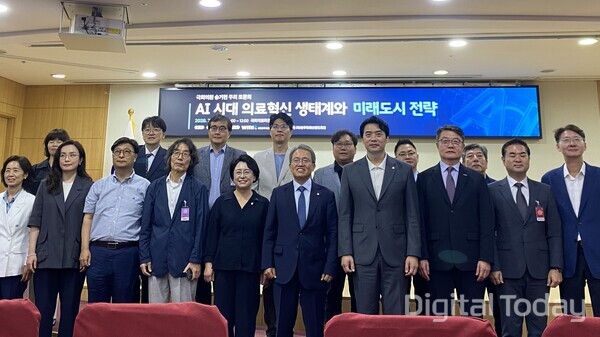
Song Gi-heon (송기헌), chair of the National Assembly’s Science, ICT, Broadcasting and Communications Committee, said on July 15 at a forum titled “Medical Innovation Ecosystem in the AI Era and Future City Strategies” that he would work to help South Korea become a leading country in AI medical innovation.
The forum was attended by lawmaker Han Jun-ho (한준호), the ruling party’s floor spokesperson on the committee, and lawmaker Kim Sun-min (김선민) of the Rebuilding Korea Party, who serves on the committee. It was co-hosted by the Wonju Medical Device Industry Promotion Institute and the Wonju Future Industry Promotion Institute.
In congratulatory remarks, Song highlighted the AI medical competitiveness of Wonju, his constituency. “Wonju has data accumulated over decades in medical devices and healthcare,” he said. “It is among the largest in South Korea.”
He also called digital healthcare and AI medical innovation a global trend. He said it was not only an issue for Wonju. He said the global healthcare market has grown beyond several hundred trillion won and that South Korea has a role to play in the market.
Han said the committee had been focused on broadcasting and communications until last year and became an issue. He said science and technology had become far more important as the country is rapidly entering the AI era after the announcement of three mega projects.
Citing his experience working in 2000 as a database researcher at the information and communications company Dacom, he said the very concept of DB operations has completely changed. He said linking it with medicine leaves a difficult issue of databasing human biological information alongside human dignity. He added that he would work at the committee level to overcome the problem and would work to establish the industry through talks with the Health and Welfare Committee, discussions among floor spokespersons and the Office for Government Policy Coordination.
Kim said he received multiple requests related to informatization when he served as head of the Health Insurance Review and Assessment Service. He said he had heard that many of those technologies are not being used in practice.
He said prospects were not bright even overseas for using AI in clinical settings. He said that meant the ecosystem should not be left to the market alone and that the government should actively step in and understand the risks. He added that AI medical innovation starting in the city of Wonju would carry a different meaning. “If it cannot succeed in Wonju, it cannot succeed in South Korea,” he said.
 Seulgi Son
sageson@d-today.co.kr
Seulgi Son
sageson@d-today.co.kr