
South Korea’s Financial Services Commission will expand the National Growth Fund to 200 trillion won and supply up to 10 trillion won to national strategic technologies. It will also push capital market reforms including structural changes to the KOSDAQ market, limits on duplicate listings and a shorter stock settlement cycle.
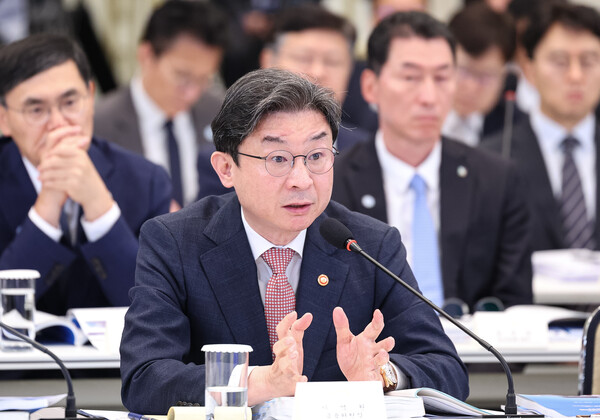
Financial Services Commission Chairman Lee Eok-won (이억원) announced the key tasks at a second-half work report chaired by President Lee Jae-myung (이재명) on July 15, saying he would move in earnest to advance financial structural reform.
The commission will expand the National Growth Fund to 200 trillion won from the current 150 trillion won. It will also broaden support targets from 12 advanced industries to future strategic industries including aerospace.
It will also increase annual support for direct equity investment, under which financial institutions share project risks, to at least 5 trillion won from 3 trillion won.
The commission will also create a new entity tentatively called Korea Strategic Technology Partners (KSTP). It plans to supply up to 10 trillion won in long-term funding to foster future foundational and core technologies as national strategic assets.
In capital markets, it will launch a "three major structural innovation programme" for the KOSDAQ market. The commission said it aims to improve demand-supply conditions and market trust in the KOSDAQ, which it described as relatively undervalued compared with the KOSPI, to encourage balanced growth in the stock market.
It will push a shift to T+1 to shorten the stock settlement cycle to 1 business day after the trade date from the current 2 business days. It will also prepare measures to pay interest on subscription deposits for initial public offerings.
It will in principle restrict duplicate listings and also push measures to enhance shareholder value, including disclosure of low price-to-book ratio (PBR) companies and steps to encourage listed companies to increase dividends.
It will also move to improve governance at financial companies. The commission plans to block so-called "entrenchment" in which a chief executive officer effectively dominates the board, and to increase the fairness and transparency of procedures for reappointment.
It will also prepare measures to overhaul financial administration and supervision across inspections, sanctions and licensing and approvals for financial firms. To promote an artificial intelligence shift (AX) in the financial sector, it will fully lift network separation regulations and revamp the credit information consent system.
Lee said, "I will push more intensively and with greater speed financial structural reform that supports an irreplaceable Republic of Korea." He added, "Based on voices from the field, we will create results that the public can feel."
 Oh Sang-yup
yub@d-today.co.kr
Oh Sang-yup
yub@d-today.co.kr