
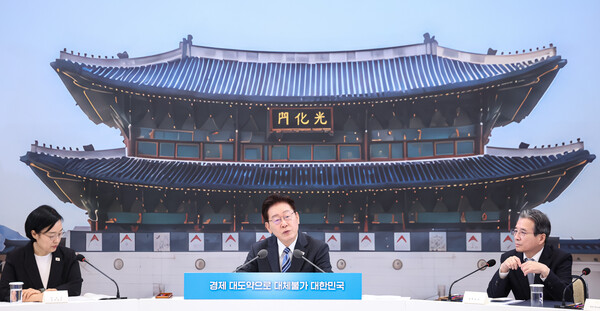
President Lee Jae-myung (이재명) ordered that swift supplementary measures be prepared for single-stock leveraged exchange-traded funds (ETFs) that have recently been at the centre of a stock market volatility controversy.
Speaking at a Financial Services Commission briefing for the second half of the year held at the state guesthouse at Cheong Wa Dae on July 15, Lee said, "When introducing an initial system or something like that, there are times when side effects can cause confusion, and that cannot be ruled out, so handle such things carefully."
He then instructed financial authorities to "swiftly prepare supplementary measures."
FSS chief Lee Chan-jin (이찬진) replied, "I will fulfil my responsibilities as a market manager."
Lee also asked Korea Exchange Chairman Jeong Eun-bo (정은보), "The Korea Exchange is also noisy because of ETFs, right?" Jeong replied, "That is right."
Lee then ordered, "Normalising and advancing the capital market is an important task, so please resolve this swiftly." Jeong replied, "I will do so."
Recently, single-stock leveraged ETFs with Samsung Electronics and SK Hynix as underlying assets have been criticised for amplifying volatility as rebalancing and hedging trades added to market swings during sharp rises and falls in domestic stocks.
Financial authorities are reviewing raising minimum deposits, strengthening mandatory investor education, restricting listings of new products and tightening management of liquidity providers' (LPs) quotes.
The Korea Financial Investment Association and the securities industry also decided to push steps to expand tailored risk warnings that consider an investor's age and portfolio, and to raise minimum deposits.
Measures are also being discussed to ease the problem of rebalancing trades concentrating at the close, including spreading out trading times and strengthening LPs' market stabilisation function.
Still, the industry is also voicing concern that investors can easily access high-multiple products linked to Samsung Electronics and SK Hynix in overseas securities markets and digital asset exchanges, meaning stronger domestic-only regulation could shift investment demand overseas.
Financial authorities are expected to prepare measures that reduce market shocks from excessive leverage investing and mechanical trading while maintaining investor choice and market competitiveness.
 Oh Sang-yeop
yub@d-today.co.kr
Oh Sang-yeop
yub@d-today.co.kr