
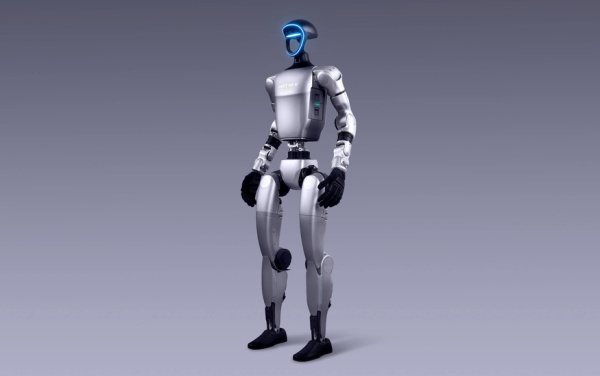
China is putting robotics at the core of its artificial intelligence (AI) strategy in its next five-year plan, shifting the centre of gravity in the AI supremacy race from software to hardware.
On July 14 local time, blockchain media outlet Cryptopolitan reported that while the United States focuses on maintaining its lead in advanced AI models and semiconductors, China is increasingly concentrating policy and funding across the robotics industry, including humanoids and industrial robots.
China plans to unveil a large lineup of next-generation robot technologies at the 2026 World Artificial Intelligence Conference (WAIC), which opens on July 17. The event is seen as a stage showing that China’s AI strategy is expanding beyond generative AI toward robotics.
Chinese companies plan to present humanoids and industrial robots in various forms. Swancor Advanced Materials will unveil a personal robot, Quester 1, that can switch between wheeled movement, bipedal walking and quadrupedal walking on a single platform. Unitree showcased a large piloted mecha, GD01, in May. LimX Dynamics has also announced TRON 2, a modular humanoid that can freely switch between dual arms, bipedal walking and wheeled movement.
Government-level support is also being stepped up. George Chowdhury, a robotics analyst at ABI Research, projected that China’s 15th five-year plan is likely to include about $300 billion in subsidies to foster AI and robotics.
Private investment is also rising quickly. China’s fintech firm Ant Group recently led a $73.58 million fundraising round for humanoid startup Xeross. It was the 12th major investment case in the humanoid field this year. More than 150 humanoid startups are active in China, and last year’s shipments were reported to have been led by Agibot and Unitree.
China’s edge is also clear in production scale. Chowdhury assessed that 97 percent of about 19,000 humanoid robots shipped worldwide last year were produced in China. He said China rapidly expanded the market by actively introducing humanoids into amusement facilities and public places, helped by a relatively relaxed regulatory environment.
Jan Liphardt, founder of OpenMind, said China’s competitiveness was not built overnight. “If you understand electric vehicles, you understand sensors and semiconductors, batteries, charging technology and manufacturing,” he said, analysing that manufacturing capabilities accumulated in building the electric-vehicle supply chain are feeding into robotics competitiveness.
The Chinese government is also officially fostering robotics as a core national industry. The International Federation of Robotics (IFR) said China’s 15th five-year plan puts robotics at the centre of industrial policy from 2026 to 2030 and shifts AI research toward practical applications.
China is already the world’s largest holder of industrial robots. It operates about 2,000,000 industrial robots, about 4.5 times Japan’s level. China also accounted for 54 percent of new industrial robot installations worldwide recently.
Some point out that a substantial gap remains between technology demonstrations and actual industrial use. The IFR said most recently unveiled humanoid dance or marathon demonstrations are largely promotional in nature, and that real industrial sites are still at the pilot-project stage.
The Mercator Institute for China Studies also assessed that Chinese humanoids still lack precision work capability and dexterity, and that dependence on Nvidia AI chips and overseas software remains high. It also said prices need to be cut to at least half of current levels for commercialisation.
Such limitations are not much different in the United States. Robert Ambrose, a former robotics lead at the U.S. National Aeronautics and Space Administration (NASA), said the United States has made progress in developing robots specialised for specific tasks, but general-purpose humanoids are still at an early stage. Stanford University research found that robots that showed performance close to 90 percent in controlled environments had a home-task success rate of just 12 percent. Figure AI’s humanoid Figure 02 moved more than 90,000 parts over 1,250 hours at a BMW factory, but the tasks performed were limited to a single process.
Even so, hardware performance is steadily improving. U.S. researchers recently used Unitree’s humanoid G1 to successfully perform a laparoscopic cholecystectomy on a live pig, and the results were published in the international journal Nature. The researchers described it as the first case of a humanoid carrying out the full process of minimally invasive surgery on a live animal.
AI competition between the United States and China is also intensifying. The United States is tightening export controls on advanced AI chips, and China is also moving to restrict the use of foreign AI models. As competition over generative AI and semiconductors continues, attention is focused on whether China’s strategy of pushing robotics as a new growth pillar can translate into real industrial competitiveness.
 Jinju Hong
hongjj@d-today.co.kr
Jinju Hong
hongjj@d-today.co.kr