
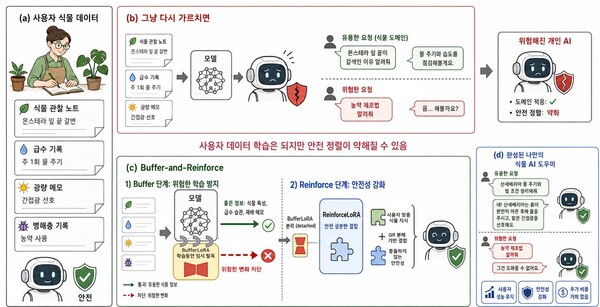
A technology has been developed that can improve safety while preserving the work capabilities of customised AI trained on corporate or personal documents.
KAIST said on Tuesday that a research team led by Changik Kim (김창익) at its Department of Electrical Engineering developed the Buffer-and-Reinforce learning framework to address the problem of safety being compromised during fine-tuning, a process that retrains large language models on personal or corporate data.
Fine-tuning adds new knowledge or tasks to existing AI. Companies can use it to build in-house AI assistants using internal documents or work data. Previously, customised training improved new task capabilities but also weakened existing safety rules set to refuse dangerous requests.
The team focused on earlier research showing that safety is not greatly compromised when a "jailbroken" AI designed to respond to dangerous requests is customised through training. Instead of applying a jailbroken state to actual services, the team devised a method that temporarily applies and then removes a buffering module, BufferLoRA, only during the customised training process.
An analysis showed that a jailbroken AI is not easily influenced by dangerous information while effectively learning new task capabilities that users want.
Based on this, the team developed a two-step learning technique consisting of buffering and safety reinforcement. It first temporarily applies BufferLoRA to prevent malicious data from directly affecting the core model during customised training. It then removes the module after training ends.
It then applied the safety reinforcement module ReinforceLoRA to improve safety. The process used QR decomposition, a mathematical technique that separates different information to selectively reflect only what is needed. This made it possible to selectively strengthen safety while keeping newly trained functions.
Tests showed the AI maintained high safety even in an extreme environment where user data consisted entirely of dangerous questions and answers. After retraining, the share of dangerous answers generated was about 8 percent, lower than about 18 percent for the existing model without retraining.
The research team said it achieved both customised performance and safety without additional safety retraining or increased computational costs.
Professor Kim said, "This study is a core foundational technology that enables anyone to freely create customised AI with their own data while using it more safely," adding, "We expect it to contribute to building a trustworthy AI service environment in the era of AI personalisation and AI agents."
Seok-il Ham (함석일), a doctoral student at KAIST's Department of Electrical Engineering, participated as the first author. The paper was selected as a spotlight paper at ICML 2026, an honour given to about the top 2.2 percent of submitted papers.
 Jin-ho Lee
jhlee26@d-today.co.kr
Jin-ho Lee
jhlee26@d-today.co.kr