
[DigitalToday reporter Jin-ho Lee] The National Information Society Agency (NIA) will conduct an on-site trial that combines AI computing functions at telecom base stations with industrial robots.
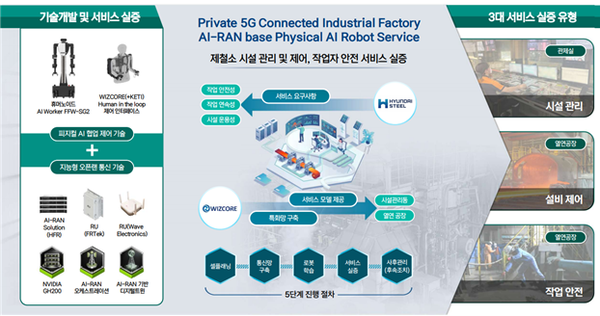
NIA said on Tuesday it is launching a trial project to build 'AI-RAN and physical AI service integration technology' at industrial sites under a Ministry of Science and ICT open call programme.
AI-RAN is a next-generation wireless network technology that combines AI computing functions with telecom base stations to optimise communications environments and support AI computing needed by nearby devices and terminals. Physical AI refers to technology that combines AI with hardware that moves in the real world, such as robots.
The project is South Korea's first on-site trial that applies high-performance graphics processing unit (GPU)-based AI computing functions to communications infrastructure and links them with physical AI, based on a dedicated 5G network known as Ium 5G. It will build the entire supply chain, from communications infrastructure to robot devices, with domestically developed technology. NIA will serve as the lead agency, with seven South Korean companies and institutions participating.
The participating organisations will build the infrastructure and conduct the on-site trial by the end of this year. The task was introduced at the AI-RAN Alliance in-person meeting as a South Korean case of AI-RAN-based physical AI verification.
The trial will be conducted at Hyundai Steel's Dangjin hot rolling plant. Existing on-site robots have faced limitations in performing complex AI inference or restoration work at the level of skilled workers due to constraints in the computing performance of onboard semiconductors and battery capacity.
NIA will implement a response structure that moves from 'on-site perception by the robot, judgement by the AI-RAN network, and actual action by the robot' in the trial. The robot will send collected on-site information to AI-RAN infrastructure, and the network will perform complex computations and judgement before delivering work commands to the robot. The network will share part of the robot's brain role, supplementing the robot's own computing performance and battery limitations.
It will also verify a multi-robot cooperative control service that connects multiple robots to a single AI-RAN network. It will test whether multiple robots can share risk information from the site in real time and divide tasks among themselves.
NIA will also conduct officially recognised testing and verification of the technology by linking a domestic '5G-A testbed' with the global 'O-RAN Global PlugFest'. It plans to complete infrastructure build-out and verification within this year, then support advancement and wider adoption through performance management over the next two years.
NIA President Hyeong-cheol Kim (김형철) said the project would serve as a catalyst for an era of physical AI that combines telecommunications, AI and physical robots. He said he expects it to help secure a verification reference that enables South Korean AI network and physical AI companies to enter global markets.
 Jin-ho Lee
jhlee26@d-today.co.kr
Jin-ho Lee
jhlee26@d-today.co.kr